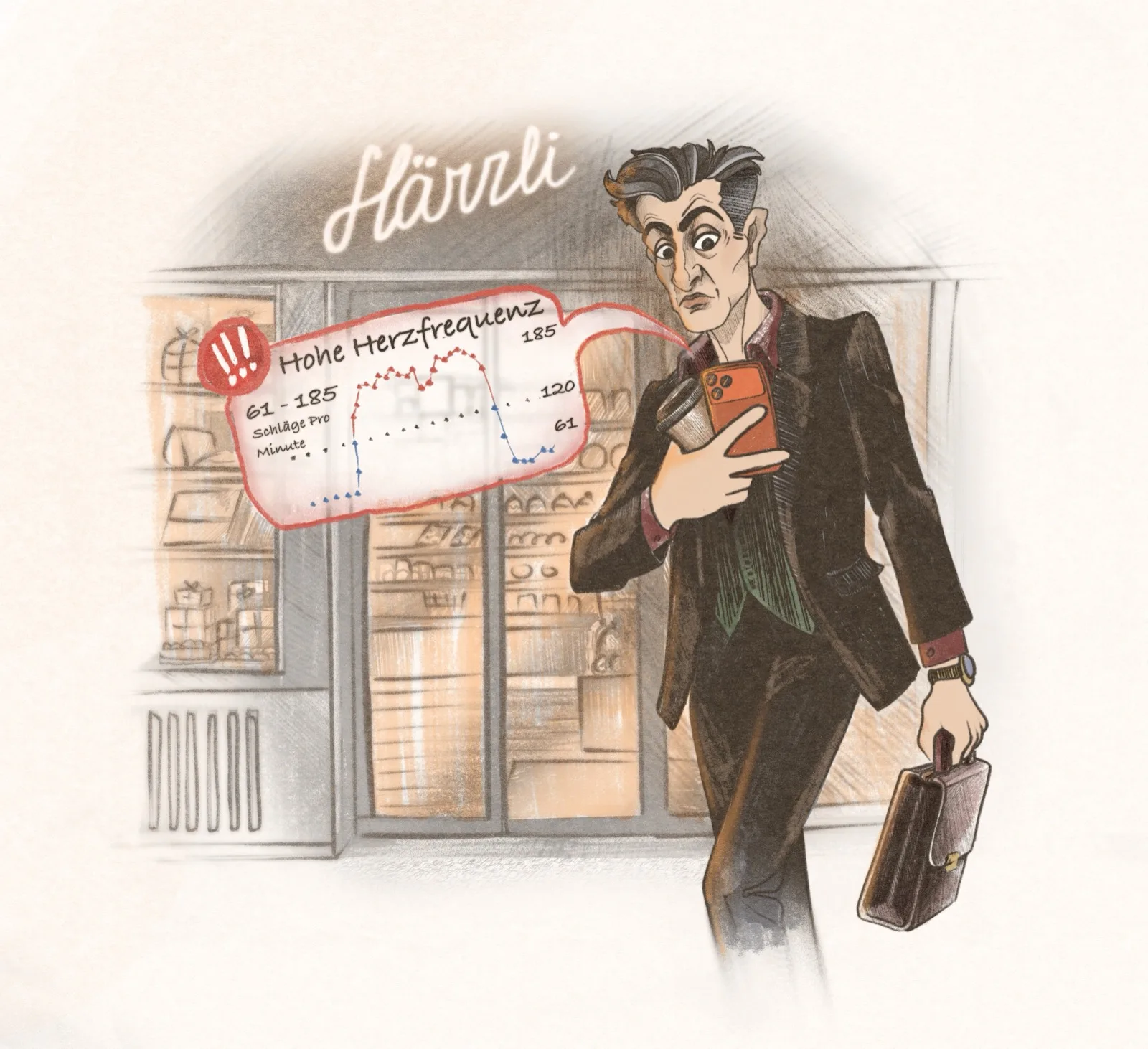
An on-average smaller coronary system, microvascular involvement, a different pattern of symptoms in the acute setting, and a body of evidence gathered for decades mostly in men. Those are four reasons why "cardiology for women" is a clinical competence in its own right. Not a marketing formula.
What women's cardiology actually means
Four biological differences that matter clinically
The overview below is the scientific basis we work from in the clinic. It is ordered by clinical relevance for you.
- Coronary anatomy and vessel size. On average, a woman's coronary arteries have a smaller lumen diameter than a man's of the same height [Sheifer SE et al., Am Heart J 2000]. Clinically, this means that identical stenoses have a greater effect on blood flow, a percutaneous coronary intervention (PCI) requires smaller materials, and some reference values from male-dominated studies cannot be transferred directly.
- Microvascular disease and INOCA. In the WISE study, around half of the women who underwent coronary angiography for chest pain showed no significant obstructive stenosis [Bairey Merz CN et al., JACC 2006]. The symptoms were real; the cause lay in the small vessels or in endothelial dysfunction. An unremarkable cardiac catheterisation is no end point here. It is where a more differentiated work-up begins (acetylcholine test, coronary flow reserve).
- Acute symptom presentation. Chest tightness remains the most common symptom in women too. In an NRMI analysis of 1.1 million MI patients, however, around 42 percent of the women presented without the classic chest pain. Among the men it was around 31 percent [Canto JG et al., JAMA 2012]. More common then are shortness of breath, nausea, pain in the upper back, arm, neck or jaw, and unusual exhaustion [Mehta LS et al., Circulation 2016].
- Hormonal transitions as turning points. Oestrogen has a vasoprotective effect. With perimenopause and menopause, this protection disappears. Blood pressure, lipid profile, body composition and vascular reactivity often change within a few years. The AHA summarises the evidence in a dedicated Scientific Statement: the menopause transition is a distinct phase of increased cardiovascular risk, independent of chronological age [El Khoudary SR et al., Circulation 2020].
These four points do not stand in isolation. They interlock and explain why a woman in her mid-50s with pressure on her chest cannot expect the same pattern as a man of the same age.
In the emergency department, the atypical female pattern has historically been classified more often as "probably gastrointestinal" or "psychogenic". Diagnosis is delayed. Care becomes worse as a result.
Why the evidence caught up so late
Until 1993, it was common practice in the USA to conduct clinical cardiology trials predominantly in male subjects. Only the NIH Revitalization Act of that year (Public Law 103-43) forced researchers to include women in phase III trials. The Lancet Commission also recapitulates this chronology [Vogel B et al., Lancet 2021]. Europe followed. The first dedicated ESC policy statement on cardiovascular disease in women appeared in 2006 [Stramba-Badiale M et al., EHJ 2006]; an ESC workshop under the title "Red alert for women's heart" followed in 2011 [Maas AH et al., EHJ 2011]. The Lancet Women and Cardiovascular Disease Commission published its assessment in 2021. It reached a sober conclusion: global cardiovascular mortality in women can only be reduced substantially by 2030 if diagnostics, therapy and research become sex-specific [Vogel B et al., Lancet 2021].
This is no historical digression. It explains why, as a patient today, you often encounter recommendations drawn from a dataset in which women were under-represented. In the women's heart clinic we discuss recommendations with an explicit note on where they come from.
What emergency departments still miss in women today
If you say "I am not sure whether this is my heart", the following rule applies for us. With shortness of breath, unusual tiredness, nausea without a clear gastric cause, or pressure or burning in the chest, back or jaw that lasts for minutes and does not depend on food intake: rule out an emergency, then investigate specifically.
This is not over-caution. The VIRGO study showed, in young STEMI patients under 55, that women were less often reperfused within the guideline-recommended time windows. Door-to-reperfusion times were also longer than in men of the same age [D'Onofrio G et al., Circulation 2015]. Every minute of ischaemia costs heart muscle cells. Whoever gets checked earlier has, statistically, more options.
When it is time to ask a cardiologist
Three thresholds at which we recommend visiting a cardiology clinic without waiting for a further trigger:
- Symptoms persist despite an unremarkable GP work-up. You have repeated chest pressure or shortness of breath on exertion that was classified as unremarkable in your GP's work-up, yet the symptoms remain.
- Elevated Lp(a) or a family history. Your blood test or a routine check shows an elevated Lp(a) value, or early heart attacks (before the age of 60) run in your family.
- Taking stock in peri- or menopause. Your cardiovascular values have been good so far, and you would like a baseline assessment before the hormonally driven changes set in for good.
One recommendation makes any statistical discussion unnecessary: if you consider yourself to be in an emergency, do not come to our clinic. Dial 144, the Swiss emergency number.
How the women's heart clinic at Dein Team works
We work as a pair. Dr. Leone conducts the first consultation and takes the history, including the gynaecological and internal-medicine turning points (pregnancies, pregnancy-related hypertension, menopause, hormone replacement therapy) that are often missing from a standard cardiology history. PD Dr. Kleinecke, as an interventional cardiologist with a habilitation (a senior academic qualification), is responsible for diagnostic decisions that imply a procedure (coronary angiography, functional tests, LAA closure where indicated).
A first consultation comprises:
- A detailed history, 45 minutes, including hormonal and pregnancy history
- Clinical examination
- Resting ECG
- Echocardiography (transthoracic)
- Laboratory values: lipid profile including Lp(a), HbA1c, thyroid values, kidney values, iron status
- Where clinically indicated, on the same day: exercise ECG or Holter ECG
At the end you sit at the table with the physician, hear the findings and take home a written report that your GP also receives. The clinic is multilingual (German, Italian, English, Spanish).
Where to read on in the cluster
The women's heart cluster on dth.healthcare is being built up piece by piece. The following topics are planned as deeper reads:
- Heart attack symptoms in women. The sex-specific acute presentation in detail.
- Microvascular angina (INOCA). When the catheter is "normal" and the symptoms remain anyway.
- Menopause and heart health. The hormonal turning point from a cardiology perspective.
- Takotsubo cardiomyopathy. Stress heart syndrome in women after menopause.
- When should my partner see a cardiologist. A decision aid for the gatekeeper of the household.
The internal-medicine side is covered too. The sister cluster at dtl.healthcare/frauenheilkunde-hausaerztlich-zuerich covers thyroid, iron deficiency and metabolism in menopause.
Frequently asked questions
Do I need a referral for the women's heart clinic?
Does health insurance cover the costs?
Is the women's heart clinic only for older women?
What is the difference between a consultation with Dr. Leone and one with Prof. Glökler?
What if my symptoms have so far been classified as psychosomatic?
Which languages do the physicians speak?
Women's heart clinic at Dein Team
First contact without a referral. Appointment usually within a week. With acute symptoms (shortness of breath, persistent chest pressure, sudden exhaustion with nausea) dial 144.
Book an appointment at the women's heart clinicAuthor: Dr. med. (I) Roberta Leone, specialist in training in Cardiology FMH, USZ + Dein Team Herzzentrum. Medically reviewed by: PD Dr. med. Caroline Kleinecke, Habilitation, FMH Cardiology, on 4 May 2026. Last updated: 4 May 2026.