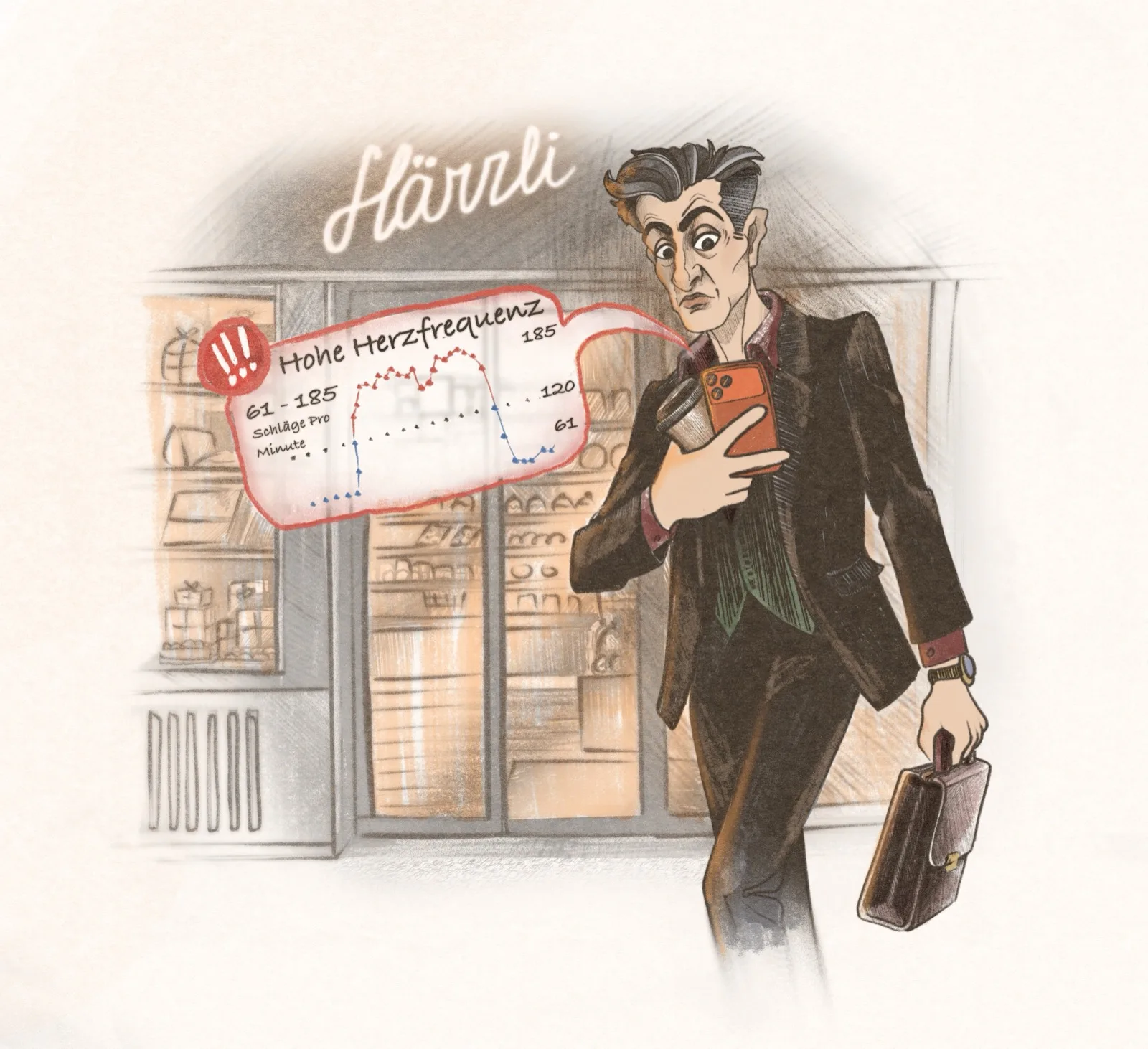
"I feel fine." That is the sentence you hear most often when you bring up a cardiologist. He means it honestly. He has no pressure in his chest, he runs at the weekend, his last GP check-up was "fine on the whole". Yet you have the feeling that something does not add up. The family history, the stress, the readings that were "just on the borderline". This text is for you. It shows you what justifies a cardiology visit in his 40s, 50s and 60s, how to open the conversation without confrontation, and what the first hour in the consultation actually clarifies for him.
What you need to know now
Why this article is addressed to you
In the consulting room we see a pattern. Men frequently do not come to their first cardiology appointment on their own initiative. They come because a woman in the background has made an appointment, had a conversation, and has a family history in mind that he himself no longer does. The Swiss Heart Foundation describes this phenomenon explicitly in its dossier on men's health: men seek help later, ask less actively, and more often become aware only through an acute event [Schweizerische Herzstiftung, Männer- und Frauenherzen 2024].
Nobody should read that as a weakness. It is an epidemiological pattern with concrete consequences. The 2021 ESC prevention guideline summarises that acute coronary syndromes in men under 65 frequently occur in a risk profile that would have been modifiable years earlier [Visseren FLJ et al., Eur Heart J 2021]. That makes you the decisive voice. You often have the comparison he lacks: you remember how his father collapsed at 58. You see that he is out of breath after three flights of stairs, although two years ago he was not.
The decision rule across three phases of life
The indication for a cardiology appointment rarely follows a single symptom. It follows a combination of age, risk profile and family history. The three phases below follow the 2021 ESC prevention logic and the 2019 AHA primary prevention guideline.
- His 40s · Baseline and family history. In the 40s, absolute cardiovascular risk is statistically still low. The ESC guideline nevertheless recommends systematic risk assessment for this age group as soon as a modifiable factor (hypertension, dyslipidaemia, diabetes, smoking, obesity) or a positive family history is present [Visseren FLJ et al., Eur Heart J 2021]. If his father or brother died or was treated with a stent before the age of 55, he belongs to a high-risk group in this phase, regardless of his current readings [Arnett DK et al., Circulation 2019]. A one-off baseline assessment with a lipid panel including Lp(a), blood pressure, ECG and echocardiography defines the starting point for all the years that follow.
- His 50s · Active management of risk factors. In the fifth decade of life, absolute risk rises markedly. For men from the age of 40 in a high-risk region such as Switzerland, the ESC prevention guideline recommends a SCORE2 risk calculation as a routine part of preventive medicine [Visseren FLJ et al., Eur Heart J 2021]. The SCORE2 algorithms estimate the combined 10-year risk of fatal and non-fatal cardiovascular events [SCORE2 working group, Eur Heart J 2021]. If the calculated value is 5 to just under 10 percent, the risk in this age group counts as elevated under ESC 2021, and from 10 percent as high [Visseren FLJ et al., Eur Heart J 2021]. A cardiology appointment is indicated if the LDL target is not reached on a statin, if blood pressure on treatment remains above 140/90 mmHg, if type 2 diabetes develops, or if symptoms on exertion appear (breathlessness on effort, a feeling of pressure in the chest, unusual exhaustion). The AHA guideline stresses that the 50s are the phase in which primary prevention has the greatest lifetime effect [Arnett DK et al., Circulation 2019].
- His 60s · Surveillance and secondary prevention. From the age of 60 the focus shifts. If he has already had an event (stent, bypass, heart attack) or has known coronary heart disease, he belongs in structured cardiological follow-up. The ESC guideline recommends annual follow-up checks with a lipid profile, echocardiography and, where appropriate, functional imaging [Visseren FLJ et al., Eur Heart J 2021]. If he has had no event so far, a baseline assessment with echocardiography, ECG and SCORE2 is standard in this phase of life, because many conditions (asymptomatic aortic valve stenosis, atrial fibrillation, diastolic dysfunction) only become clinically apparent in this age range and can be detected before an acute event [Schweizerische Herzstiftung, Männer- und Frauenherzen 2024].
"I feel fine." What this sentence is worth medically, and where its limits lie
His subjective sense of wellbeing is an important clinical data point. It is, however, not a complete one. The ESC prevention guideline points out that many first cardiovascular events occur in people who previously felt subjectively healthy and whose modifiable risk factors would have been measurable years earlier [Visseren FLJ et al., Eur Heart J 2021]. Asymptomatic hypertension, asymptomatic dyslipidaemia and subclinical atherosclerosis are three findings that leave subjective wellbeing untouched for years and still change the 10-year risk substantially.
In practice this means two things. First: when you raise a cardiology appointment with him, the point is not to deny him his own perception. Second: a baseline assessment in the asymptomatic phase gives him a data point he would not have without an appointment. It can reassure him, or it can pick up a small, readily treatable change early. Both outcomes are an answer. Both are better than the gap.
Many first cardiovascular events occur in people who previously felt subjectively healthy and whose modifiable risk factors would have been measurable years earlier.
How to open the conversation without it sounding like a diagnosis
The conversation at home is often the harder part. Defensive reactions come from the impression that someone is "telling him what is wrong with him". In practice, three phrasings work better than a clinical justification.
- "I want us both to know." You turn the question into something shared. A baseline assessment is a stocktake rather than a vote of no confidence, and it has consequences for both of you.
- "Your father was 58 at the time. I simply want to have the data point." If the family history exists, it is the most honest anchor. He knows this story. You help him not to push it away.
- "One hour, once, and then you have a report." Concrete and limited. Men who come to a first appointment value that it is finite. A baseline assessment is no open-ended start to treatment; it has a clear beginning and a clear end.
- "I called for you, the appointment is on Thursday." If you know he will not book on his own initiative, you can take that step for him. At Dein Team Herzzentrum a phone call is enough; no referral is needed.
- "What you do with it afterwards is up to you." You take pressure out of the conversation by making it clear that the appointment itself is no commitment to treatment. That is also factually true: for many men, a baseline assessment ends in a simple confirmation that no intervention is needed.
If he still declines, that is his right. You have set the anchor. In our experience, many men come back three to six months later, once an observation has become persistent (sustained high blood pressure, a reading on the GP's report, a symptom of their own).
What the first cardiology hour actually does for him
A first cardiology consultation at Dein Team Herzzentrum usually takes 60 to 90 minutes and includes the following elements. They are structured so that at the end of the hour there is a written assessment, which he and his GP receive.
- History with risk profile. Family history across two generations, lifestyle factors, previous readings. Points often come up here that have no room in a 15-minute GP consultation.
- Resting ECG. Standard procedure, takes a few minutes. Provides indications of rhythm disorders, signs of ischaemia, hypertrophy.
- Echocardiography. Structural assessment of the heart: pump function, valves, wall thickness, diastolic function. Identifies subclinical findings (left ventricular hypertrophy as end-organ damage in hypertension, asymptomatic valve pathologies) [Arnett DK et al., Circulation 2019].
- Extended lipid panel including Lp(a) and ApoB. Lp(a) is a genetically determined risk factor that should be measured once in a lifetime and is often missing from routine testing [Visseren FLJ et al., Eur Heart J 2021].
- 24-hour blood pressure monitoring (ABPM). When home and practice readings differ or hypertension is suspected. Captures the nocturnal dipping profile and masked hypertension.
- SCORE2 calculation and written assessment. The report contains the calculated 10-year risk, the indication for or against drug treatment, and concrete lifestyle advice. A copy goes to his GP at the same time.
What you get from this as his partner: a data point that you can both work with. If the report is unremarkable, you have real reassurance instead of an "I think it's okay" answer. If it shows something, there is a concrete treatment recommendation. In both cases the gap is closed.
When a normal appointment is not enough and you dial 144
This decision guide applies to non-acute situations. There are symptoms for which you do not book a consultation. You dial 144, the Swiss emergency number, directly:
- Sudden, persistent pressure or pain in the chest, often radiating to the arm, jaw or back.
- Sudden, severe breathlessness at rest.
- Sudden neurological symptoms (speech disturbance, one-sided weakness, loss of vision).
- Syncope (brief loss of consciousness) without a clear cause.
- Persistently very high blood pressure (above 180/120 mmHg) with symptoms.
These situations are an indication for the emergency department. As a reminder: the symptoms of an acute coronary syndrome can look different in women than in men, with nausea, exhaustion, breathlessness and upper abdominal pain. In men, classic retrosternal pressure with radiation more often dominates [Mehta LS et al., Circulation 2016]. Both patterns count as an emergency.
Frequently asked questions
:::faq
My husband is 45, healthy, does not smoke and exercises. Should he still see a cardiologist? If there is no family history and no elevated readings, a baseline assessment in his 40s is not a compelling indication. It becomes worthwhile when a modifiable factor is added (high blood pressure, elevated LDL, diabetes), when there is a family history, or when he notices symptoms on exertion [Visseren FLJ et al., Eur Heart J 2021]. A once-in-a-lifetime Lp(a) measurement is advisable even with a low risk profile, because this value is genetically determined and lies in the elevated range in around 20 percent of the population.
His father had a heart attack at 56. Is that reason enough? Yes. Cardiovascular disease in the father or brother before the age of 55 (or in the mother or sister before 65) counts as a positive family history and, under the AHA/ACC guideline, is an independent indication for extended risk assessment, regardless of current symptoms [Arnett DK et al., Circulation 2019].
GP or cardiologist as the first step? Most pathways sensibly begin with the GP, because that is where the lipid panel, blood pressure screening and a basic ECG are done. A cardiology appointment complements this when the readings remain elevated, when equipment-based diagnostics (echocardiography, ABPM) are needed, or when there is a family history. At Dein Team Herzzentrum no referral is needed; many patients come directly.
He is afraid of a bad diagnosis. How do I deal with that? This fear is common and it is legitimate. In practice it helps to frame the appointment as a baseline assessment rather than as the work-up of a suspected illness. Statistically, the majority of men in their 40s and early 50s leave the first appointment with an unremarkable or readily treatable finding. The consultation is set up for these conversations.
What does a first cardiology consultation cost in Switzerland? A first cardiology consultation with ECG and echocardiography is billed to basic health insurance (Grundversicherung, the compulsory Swiss health insurance) if there is an indication (symptoms, risk factors, family history). Self-pay packages for baseline assessments without an indication are also possible. The practice communicates the conditions in advance.
Who carries out the examination at Dein Team Herzzentrum? The first consultation is with one of the practice's FMH board-certified cardiologists (Prof. Dr. Steffen Glökler, PD Dr. med. Caroline Kleinecke, Dr. med. Steffen, or Dr. Leone in training under supervision). Findings are assessed as a team. You will see the same physician for follow-up checks.
My husband works 60-hour weeks. How do I fit an appointment in? The consultation offers appointments before 8 am and after 5 pm. A first consultation with ECG, echocardiography and laboratory tests can be bundled into a single session of 60 to 90 minutes, so no second appointment is needed.
:::
<a href="https://dth-herzzentrum.ch/termin/sprechstunde" class="btn btn--primary">Termin vereinbaren</a>
Dr. med. (I) Roberta Leone, specialist in training, Cardiology FMH, USZ + Dein Team Herzzentrum. Medically reviewed by PD Dr. med. Caroline Kleinecke, Habilitation, FMH Cardiology, interventional cardiology. Reviewed on 4 May 2026.