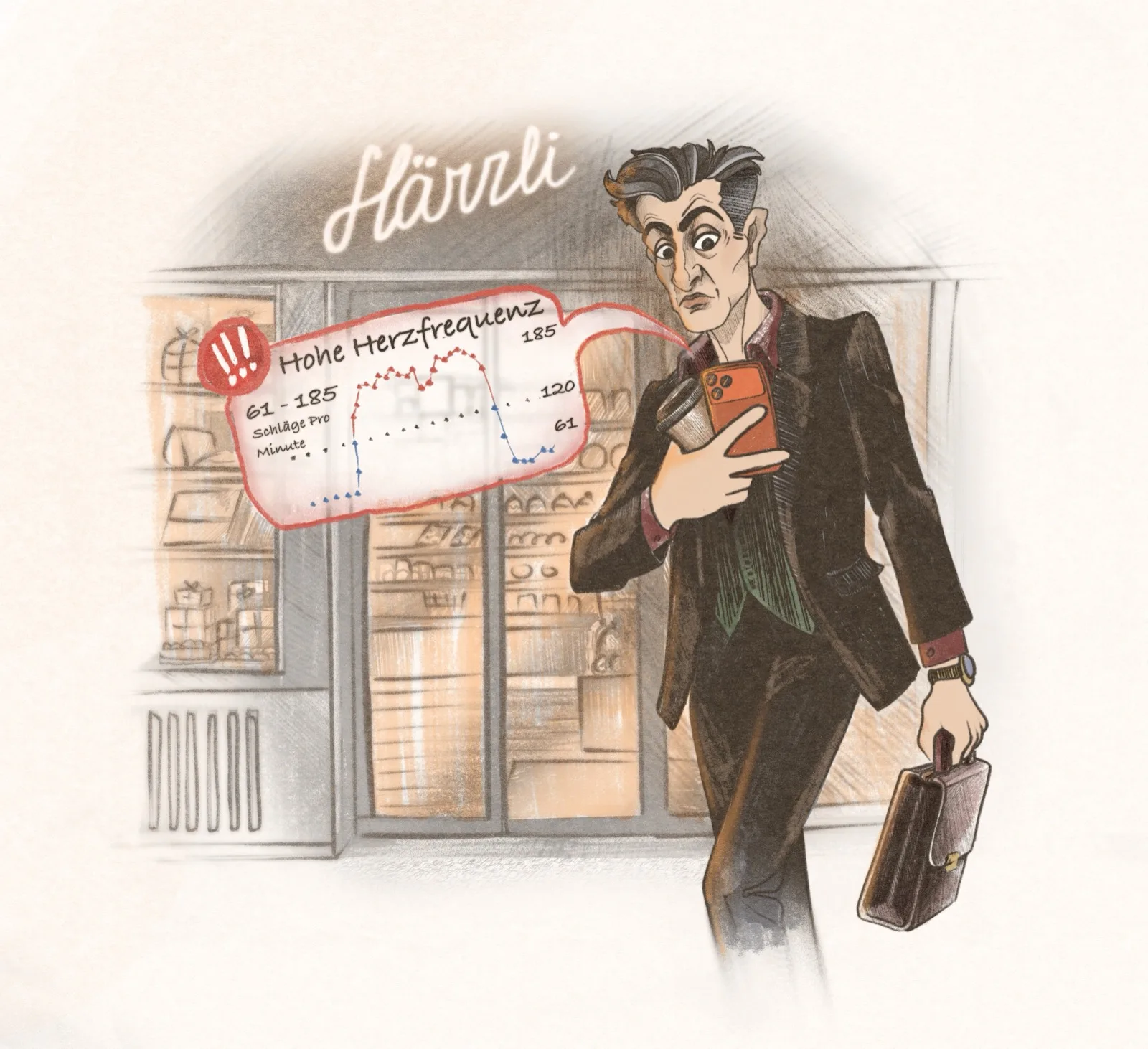
Values that were still optimal at 47 can put you in a different risk class at 53. Age alone does not explain this. The hormonal transition shifts blood pressure, lipid profile, vascular reactivity and body composition at a pace that sets a cardiac assessment at 50 apart from the same examination at 40. In 2020, the American Heart Association classified this phase as a distinct period of cardiovascular risk. In Switzerland, one in three women dies of cardiovascular disease [Schweizerische Herzstiftung 2024].
What the menopause does to your heart
The hormonal logic. Oestrogen, endothelium and the vasoprotective effect
Oestradiol acts directly on the endothelium, the innermost cell layer of the blood vessels. It promotes the release of nitric oxide, keeps the vessels dilated, reduces oxidative stress and has a favourable influence on the lipoprotein profile. As long as the ovary produces oestradiol cyclically, this protection works quietly in the background. With the perimenopause, production becomes irregular; after the menopause it largely ceases.
The AHA working group led by El Khoudary concludes from the evidence that this loss can have measurable consequences for endothelial function, lipid metabolism and vascular reactivity. These changes go beyond what would be expected from chronological ageing alone [El Khoudary SR et al., Circulation 2020].
This matters because it corrects a widespread assumption. For a long time the view was that women were cardiovascularly protected until the menopause and thereafter gradually developed the risk profile of men. The data paint a different picture. The shifts begin during the perimenopause, years before the final menstrual period, and they often proceed faster than a linear course of ageing would predict [El Khoudary SR et al., Circulation 2020].
What changes physiologically
The following four systems underpin the AHA's description of the menopause transition. They are measurable, and they can alter your clinical picture.
- Blood pressure. With the perimenopause, systolic blood pressure can rise into the borderline or hypertensive range for the first time in some women. The AHA points to longitudinal cohort data showing a hormonal contribution separate from the pure age effect [El Khoudary SR et al., Circulation 2020]. In clinical terms: a value that was normal before the perimenopause may require treatment at 52.
- Lipids and ApoB. LDL cholesterol frequently rises in this phase, as does ApoB. HDL function changes qualitatively, so the HDL value alone often no longer reflects risk well. The AHA recommends measuring ApoB and Lp(a) in this phase alongside the classic lipid profile [El Khoudary SR et al., Circulation 2020]. The 2021 ESC prevention guideline supports this direction and uses non-HDL-C or ApoB to refine risk estimation [Visseren FLJ et al., EHJ 2021].
- Vascular reactivity and arterial stiffness. Endothelial function and the compliance of the large arteries can decline. Pulse wave velocity and carotid IMT, as surrogate parameters, tend to rise. These subclinical changes often occur before clinical symptoms and are particularly dynamic in this phase [El Khoudary SR et al., Circulation 2020].
- Body composition. Fat shifts from the gluteofemoral region to the abdomen. Visceral fat increases, often without a marked rise in overall body weight. This shift correlates with insulin resistance and with subclinical atherosclerosis [El Khoudary SR et al., Circulation 2020].
These four systems interlock. A woman whose blood pressure and ApoB rise in the perimenopause while she gains visceral fat is moving along three risk axes at once. SCORE2 under the 2021 ESC guideline captures this in a composite ten-year risk [Visseren FLJ et al., EHJ 2021].
The menopause transition is a distinct phase of elevated cardiovascular risk. It cannot be reduced to chronological ageing. Early identification and modification of risk factors in this phase holds the greatest clinical potential.
The perimenopausal window. Where intervention has the greatest leverage
The perimenopause typically spans the four to eight years before the final menstrual period and the first year after it. In this phase the shifts described proceed fastest. This is where the clinical leverage is greatest, for two reasons.
First, many changes in this phase are still reversible or modifiable. A blood pressure value that becomes borderline at 51 can often still be brought back into the target range through lifestyle, sleep quality and, where necessary, medication, before it becomes structurally entrenched. A rising ApoB value can be addressed in a targeted way. Second, this phase frequently produces a woman's first objective risk profile, one that the vasoprotective effect of oestrogen previously masked. What becomes visible can be treated.
The 2021 Lancet Commission concludes that a substantial reduction in the global burden of cardiovascular disease in women by 2030 is likely to be achievable only if diagnosis and treatment become sex-specific. The menopause transition is named there as a priority point for intervention [Vogel B et al., Lancet 2021]. A European consensus group led by Maas and Regitz-Zagrosek examined cardiovascular health after the menopause transition in detail in 2021 and supported the same approach [Maas AHEM et al., EHJ 2021].
A cardiac assessment. What belongs in it
An assessment in the perimenopause or early postmenopause is more than a routine check-up with a few extra items. It is an examination in its own right with a defined inventory. What belongs in it follows directly from the AHA 2020 recommendation and the 2021 ESC prevention guideline.
- History including gynaecological and internal-medicine turning points. Pregnancy-related hypertension, pre-eclampsia, gestational diabetes, premature menopause before 40, hormone therapy, migraine with aura. These points are often missing from the standard cardiology history and are relevant in this phase [Mehta LS et al., Circulation 2016].
- Extended lipid profile. Classic lipid profile plus ApoB plus a one-off Lp(a). Lp(a) is genetically determined and only needs to be measured once in a lifetime, but in this phase it is often measured for the first time [Visseren FLJ et al., EHJ 2021].
- Blood pressure profile. A 24-hour blood pressure measurement rather than a single reading in the practice. Masked hypertension is common in the perimenopause.
- Glycaemic parameters. Fasting glucose and HbA1c. Where fat is distributed viscerally, an oral glucose tolerance test may be added.
- Echocardiography and ECG. A structural baseline for reference. Even an unremarkable finding serves as the baseline for the next examination in five years.
- SCORE2 and, where applicable, SCORE2-OP. A composite ten-year risk according to ESC 2021. In specific constellations (high Lp(a), family clustering, a history of pregnancy-related hypertension), risk modifiers are applied [Visseren FLJ et al., EHJ 2021].
This assessment forms the basis for every further decision. Whether lifestyle measures are sufficient, whether statin therapy is an option, whether antihypertensive therapy should begin, whether hormone replacement therapy is to be judged cardiovascularly neutral, favourable or critical. All of this presupposes these data. Without them, advice remains general.
Three thresholds beyond which you should stop waiting
When to book a cardiac assessment rather than wait for the next occasion:
- You are in the perimenopause and have not yet had a cardiac assessment. Changes in your cycle, hot flushes, sleep disturbances, new blood pressure readings. In this phase an assessment makes sense even if you feel healthy.
- Your blood pressure or your lipid profile has changed. A value that was normal at 45 is elevated at 52. Your GP has not yet measured ApoB or Lp(a). The cardiology consultation takes up this diagnostic work systematically.
- You have a relevant history. Pregnancy-related hypertension, pre-eclampsia, gestational diabetes, early menopause before 40, a family history of early heart attacks, migraine with aura. These points shift the risk profile and belong in a cardiological evaluation at this stage of life [Mehta LS et al., Circulation 2016].
In an emergency, you do not go to the consultation. You dial 144, the Swiss emergency number. Persistent chest pressure, shortness of breath without exertion, sudden exhaustion with nausea, or pain radiating to the back, arm or jaw can be warning signs of acute ischaemia [Mehta LS et al., Circulation 2016].
How the women's heart consultation at Dein Team Herzzentrum works in this phase
The team works in pairs in this consultation. The initial conversation and the extended history cover the gynaecological and internal-medicine turning points. The diagnostic strategy includes the question of whether abnormal findings call for further functional testing, such as stress echocardiography, stress MRI or coronary function tests.
A first consultation comprises history, echocardiography, ECG, 24-hour blood pressure measurement, an extended lipid profile with ApoB and Lp(a), HbA1c and a SCORE2 calculation. The report goes to you and to your GP or gynaecologist on the same day or the following day. If hormone replacement therapy is being discussed, we coordinate the cardiological assessment with the gynaecological indication. The internal-medicine and metabolic side (thyroid, iron deficiency, insulin resistance) is covered in the sister cluster at dtl.healthcare/frauenheilkunde-hausaerztlich-zuerich. Billing follows TARDOC, the Swiss outpatient tariff.
Where to read on in this cluster
- Women's Heart cluster hub. An overview of sex-specific differences in the cardiovascular system.
- Hormone replacement therapy and the heart. What the current evidence says about HRT and cardiovascular risk.
- Microvascular angina (INOCA). When symptoms persist but the coronary angiogram is unremarkable.
- Heart attack symptoms in women. The acute side, with a decision rule for the emergency situation.
- Heart rhythm disorders in pregnancy and the menopause. Palpitations across the stages of a woman's life.
Frequently asked questions
:::faq
From what age is a cardiac assessment worthwhile?
It is worthwhile from the onset of the perimenopause, typically from the mid-40s. With a relevant history (pregnancy-related hypertension, pre-eclampsia, early menopause before 40, family clustering) it may be indicated earlier. This means a structured assessment in a phase in which cardiovascular parameters shift measurably [El Khoudary SR et al., Circulation 2020]. It does not mean blanket screening of people without symptoms.
Is a GP check-up not enough in this phase?
The GP check-up covers the basics. In the perimenopause, a 24-hour blood pressure measurement, an extended lipid profile with ApoB and a one-off Lp(a), a SCORE2 risk estimate according to ESC 2021 and an echocardiogram as a reference image are often added [Visseren FLJ et al., EHJ 2021]. These elements belong in the cardiology consultation.
Does my risk rise abruptly with the final menstrual period?
No. The shifts begin years before the final menstrual period, during the perimenopause, and continue across the menopause transition. That is precisely the core message of the 2020 AHA statement. The phase is regarded as a distinct risk period rather than a single point in time [El Khoudary SR et al., Circulation 2020].
What about hormone replacement therapy and the heart?
The assessment depends on the timing of initiation, the preparation, the route of administration and the individual cardiovascular risk profile. The European consensus group led by Maas recommends that the indication be reviewed jointly by gynaecology and cardiology, particularly in women with an elevated risk profile [Maas AHEM et al., EHJ 2021]. A detailed discussion can be found in the article Hormone replacement therapy and the heart.
I have hot flushes and palpitations. Is that dangerous?
Vasomotor symptoms are frequently accompanied by palpitations. In most cases they are harmless. A cardiological work-up serves to rule out a relevant rhythm disorder and to draw an objective picture, rather than attributing the symptoms wholesale to hormones. More on this in Heart rhythm disorders in pregnancy and the menopause.
What does an assessment in the women's heart consultation cost?
The consultation is billed to basic health insurance (Grundversicherung) if there is a cardiological indication (symptoms, risk factors, relevant history). A purely preventive check-up without an indication runs through supplementary insurance or is paid privately. We clarify the exact classification by phone when your appointment is arranged.
Do I need a referral?
No. In Zürich you can register directly. If you are in a GP model (Hausarztmodell) with your health insurer, we clarify the arrangements at first contact.
:::
<a href="https://dth-herzzentrum.ch/termin/frauenherz-sprechstunde" class="btn btn--primary">Termin vereinbaren</a>