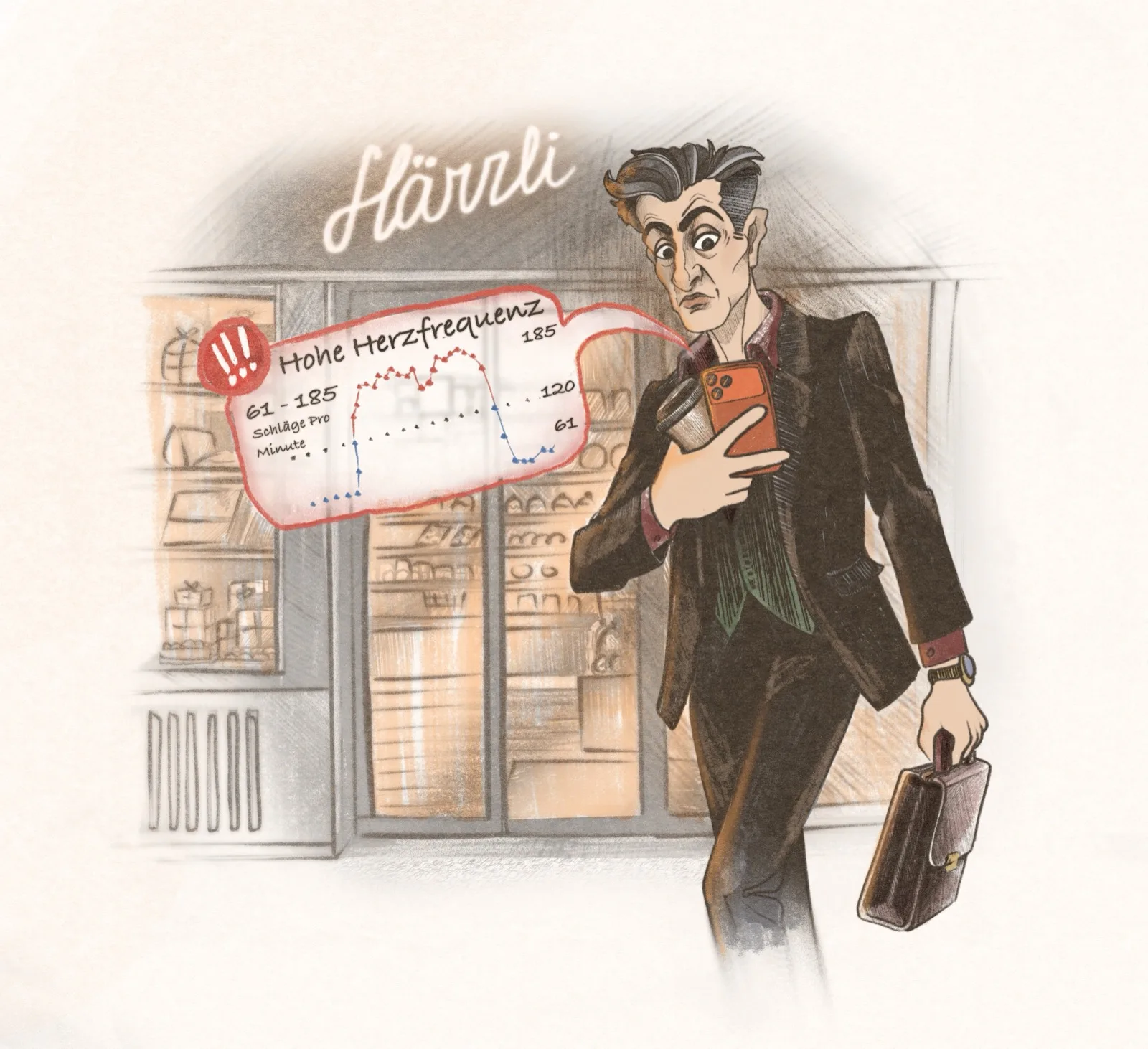
A patient in her mid-forties arrives at an emergency department with pressure in the upper abdomen, shortness of breath and a sense that something is wrong. She waits two hours, receives a gastrointestinal diagnosis and goes home. Three days later, the hospital documents a heart attack that has already occurred. Such cases are not the rule. They are more common, however, when the patient is a woman, and the research has a name for them. This page sets out what the evidence shows, where the gap comes from, and which specific sentences you can use in an acute situation.
The short answer, before you read on
What "missed" means in the data
A missed heart attack can mean two different things. First, the true failure: a patient leaves the emergency department with a wrong diagnosis and the infarction is found hours or days later. Second, the delay: the diagnosis is made, but later than in a comparable male case, with measurable consequences for the reperfusion window.
Both phenomena have been quantified. A multicentre US study of 10,689 patients with cardiac symptoms found that around 2.1 percent of infarction cases were initially not admitted from the emergency department. In the subgroup analysis, women under 55 were markedly more likely to be wrongly discharged than the reference group (odds ratio 6.7, 95 percent confidence interval 1.4 to 32.5) [Pope JH et al., NEJM 2000]. The confidence intervals are wide (a small subgroup), yet the point estimate is clinically meaningful and has been cited for two decades. In 2021, the Lancet Women and Cardiovascular Disease Commission placed this disparity in a global action plan and describes it as the product of patient, physician and system factors combined [Vogel B et al., Lancet 2021].
Three mechanisms that contribute to the delay
The delay rarely arises at a single point. Three mechanisms act together.
- Symptom presentation beyond the textbook. Chest pain remains the most common single symptom in women too. Yet around 42 percent of female infarction patients present without this classic chest pain [Mehta LS et al., Circulation 2016]. Atypical leading symptoms such as shortness of breath, nausea, upper abdominal pressure or unusual exhaustion fall outside a triage grid historically calibrated to a male-dominated symptom catalogue.
- Attribution of the complaints before triage. In the VIRGO study, women under 55 reported more often than men of the same age that they had initially attributed their symptoms to stress, muscle tension or a gastrointestinal cause. The initial medical assessment in the emergency department also more often proceeded without cardiac suspicion [Lichtman JH et al., Circulation 2018]. This early attribution shapes the next steps.
- A feeling that "something is wrong" as a finding to be taken seriously. Sudden-onset anxiety or a "sense of impending doom" is among the clinically described symptoms of acute infarction and is listed in the AHA statement on acute symptoms in women [Mehta LS et al., Circulation 2016]. It is no psychological side effect. It is a clinical clue that does not replace the ECG yet should raise the index of suspicion.
Door-to-ECG, door-to-balloon. What the clock shows.
The second part of the evidence concerns speed once the patient arrives. The VIRGO analysis by D'Onofrio and colleagues examined 1,465 STEMI cases in patients under 55 at 103 US hospitals. Women more often went untreated (9 percent versus 4 percent of men), and they exceeded the recommended in-hospital reperfusion time windows for percutaneous coronary intervention more often than men of the same age (41 percent versus 29 percent, odds ratio 1.65, 95 percent confidence interval 1.27 to 2.16) [D'Onofrio G et al., Circulation 2015]. In transferred patients the effect was even more pronounced.
The 2023 ESC guideline on acute coronary syndromes sets the reperfusion targets independently of sex: primary PCI within 120 minutes of first contact with the medical system in STEMI is a Class I recommendation. It applies equally to every patient, female or male [Byrne RA et al., EHJ 2023]. The gap does not arise in the guideline. It arises in its application.
Among young patients with myocardial infarction, women were significantly more likely than men to report that providers had not initially thought their symptoms were heart-related.
What you can actually say in the emergency department
In an acute situation, prepared, matter-of-fact language helps. There is nothing pushy about it; it is the language of an informed patient. Three sentences that put the triage conversation in the right order.
- Name the suspicion as well as the symptom. "I have had pressure in my chest or upper abdomen, shortness of breath and cold sweats for 40 minutes. I am asking for an ECG and a troponin test because I would like a cardiac cause checked." This wording moves the diagnostics from the gut feeling of triage into structured acute cardiology.
- Raise the time window directly. "If a heart attack is involved, the time window counts. Could you please tell me when the ECG will be taken and when the first troponin will be drawn." This makes the door-to-ECG time an explicit variable instead of leaving it to routine.
- Have a second person with you. A companion listens in, notes the times and can ask questions if the patient herself cannot in the acute moment. For Marco, or any partner: this is the most important contribution a companion can make.
What you cannot do yourself, the clinic does. ECG and high-sensitivity troponin are the two tests that confirm or rule out an acute infarction at first contact. If the first troponin is unremarkable, a second follows after one hour (or three hours, depending on the algorithm). The 2023 ESC guideline sets out these algorithms [Byrne RA et al., EHJ 2023]. An emergency department that works in this order rarely misses a heart attack.
What is changing in Switzerland
The Swiss Heart Foundation (Schweizerische Herzstiftung) addresses the topic in a dedicated dossier ("Bei Frauen ist der Herzinfarkt anders", heart attacks are different in women). It names shortness of breath, nausea, back pain and unusual exhaustion as symptoms that can occur on their own in women, and urges people to consider a heart attack when in doubt, even without classic chest pain [Schweizerische Herzstiftung 2023]. This awareness has reached broad public health communication.
In acute care, the change is under way. The 2021 Lancet Commission names three measurable levers: a standardised ECG request for every female patient with thoracic or atypical symptoms, women-specific training for emergency teams, and sex-stratified door-to-balloon times as a quality indicator [Vogel B et al., Lancet 2021]. What you can do as a patient is half the distance. The other half is system work.
When a cardiac check-up makes sense (outside the emergency)
Perhaps you are reading this outside an acute moment, because an earlier episode still lingers or because of a family history. A planned cardiological assessment then brings clarity. Three situations in which we readily recommend it.
- An unexplained episode in recent months. You remember a phase of persistent chest or upper abdominal pressure, shortness of breath or unusual exhaustion lasting several hours, with no cardiac work-up at the time. An old ECG, a comparison ECG, a troponin test (even after the event), an echocardiogram and a targeted history usually give a clear picture.
- A family history of early heart attacks. A father under 55 or a mother under 65 with myocardial infarction among first-degree relatives is an independent risk factor that standard preventive care often misses. In our consultation, we supplement the classic risk analysis with Lp(a), screening for familial hypercholesterolaemia and, where appropriate, a calcium score.
- Peri- or menopause with new complaints. As oestrogen declines, blood pressure, lipid profile and vascular reactivity often change within a few years. An assessment in this phase lets the changes be placed in context before they become entrenched.
If none of these clearly applies but you still feel uncertain: the first consultation in the women's heart clinic (Frauenherz-Sprechstunde) serves exactly this purpose. First contact without a referral, appointment usually within a week.
Where to read on in this cluster
- Heart attack symptoms in women. What the textbooks miss. The six most common female leading symptoms, with frequency figures from the AHA and the Swiss Heart Foundation.
- Chest pain in women. When to see a doctor. The non-acute differential diagnosis. When reflux, muscle tension or an anxiety disorder is more likely, and when a cardiac work-up follows.
- Microvascular angina (INOCA). When the catheter and exercise test are unremarkable and the symptoms persist regardless.
- Cluster hub: the women's heart. The overview in which this article sits.
Frequently asked questions
Are women really misdiagnosed more often than men?
What does "door-to-ECG" mean, and why does this number matter?
My GP says it is "just stress". Should I accept that?
What do I say when I or my partner go to an emergency department?
When do I dial 144 instead of driving myself?
Am I too young for a heart attack in my early forties?
What if, looking back, I suspect I had a heart attack?
Women's heart clinic at Dein Team
First contact without a referral. Appointment usually within a week. In case of acute symptoms, dial 144.
Book an appointment in the women's heart clinicAuthor: Dr. med. (I) Roberta Leone, Specialist in training, Cardiology FMH, USZ + Dein Team Herzzentrum. Medically reviewed by: PD Dr. med. Caroline Kleinecke, Habilitation, FMH Cardiology, on 4 May 2026. Last updated: 4 May 2026.