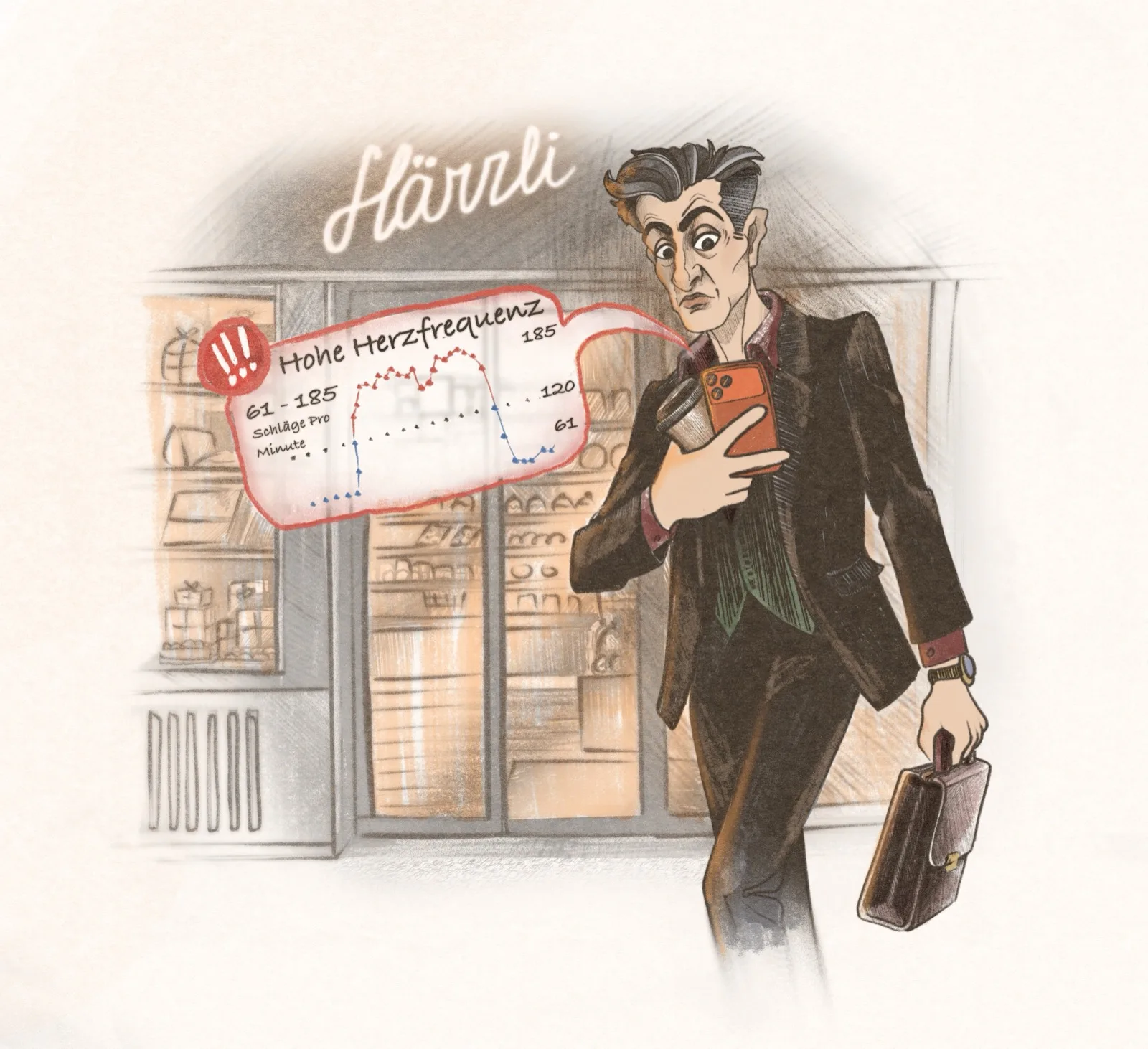
The pressure comes on Sunday evening, lasts a quarter of an hour and is gone by Monday. You book an appointment anyway, because something did not feel right. At your GP you hear the sentence many women know: "Let's keep an eye on it." This page gives you the decision rule that should stand behind that sentence. It shows when watching is right, when it waits too long, and which phrases to use in the consultation and in the emergency department. It is the practical companion to the question of why women's symptoms have historically been classified as non-cardiac more often.
The short answer, before you read on
What stands behind "let's keep an eye on it"
"Let's keep an eye on it" is not wrong as a strategy. It becomes wrong when three things are missing. A baseline ECG. A clearly defined return criterion. A deadline after which the strategy is actively reviewed. When all three are in place, watchful waiting is medically sound. When one is missing, you are watching a gap rather than a patient.
In the VIRGO study of patients under 55, 53.4 percent of the women who had previously seen a doctor reported that the treating clinician initially did not classify their symptoms as cardiac. Among the men it was 36.7 percent [Lichtman JH et al., Circulation 2018]. This gap does not live in the guidelines. It lives in how they are applied. The 2021 AHA chest pain guideline responded and explicitly added women-specific recommendations, with high-sensitivity troponin as the preferred test whenever an acute coronary syndrome is suspected [Gulati M et al., JACC 2021].
The decision rule in three thresholds
These are the same thresholds we apply in the Women's Heart Clinic. They do not replace a medical examination. They structure your own approach.
- Threshold 1. Call 144, no discussion. Chest pressure lasting over 10 minutes at rest or on minimal exertion. Combined with breathlessness, cold sweat, nausea, sudden weakness, new fainting, radiation into both arms, neck or jaw. Sudden-onset anxiety or a feeling that something is wrong counts as an accompanying symptom. It is not the explanation. The 2023 ESC acute guideline aims for primary PCI within 120 minutes of first medical contact in STEMI [Byrne RA et al., Eur Heart J 2023]. Driving yourself delays that window.
- Threshold 2. Cardiological assessment within a few days. Reproducible chest pressure or tightness on exertion, stress or cold that disappears within minutes of stopping. New breathlessness on exertion, unfamiliar exhaustion together with chest symptoms, an unexplained episode in recent weeks. A family history of early heart attacks (mother under 65, father under 55), elevated Lp(a), a history of pregnancy hypertension or pre-eclampsia, early onset of menopause. Perimenopause or menopause with new symptoms belongs in this threshold, because blood pressure, lipid profile and vascular reactivity often change quickly in this phase. The 2024 ESC chronic coronary syndromes guideline grades pre-test probability by age, sex and pain character, and ranks cardiac CT as the preferred first step at low to intermediate probability [Knuuti J et al., Eur Heart J 2024].
- Threshold 3. GP plus active monitoring. Localised palpation-dependent pain, clearly postprandial or positional, without an exertion pattern, without breathlessness, without cold sweat, in a low-risk constellation. GP assessment with a baseline ECG, a documented return criterion ("if the pain comes on with exertion, if it lasts longer than 20 minutes, if breathlessness joins it") and a specific follow-up appointment in two to four weeks. Any change is escalated to cardiology.
Three thresholds, three responses. The most common clinical question in the consultation is rarely "Am I having a heart attack?". It is "Am I sitting on threshold 2 without noticing?". That is exactly what threshold 2 and the women's heart assessment are made for.
The differential diagnosis that continues beyond coronary heart disease
In women, coronary heart disease is one diagnosis among several. Four conditions that predominantly affect women are frequently missed in the standard work-up when the coronary angiogram is unremarkable and the search stops there.
- Microvascular angina (MVA, INOCA). Exertion- or stress-related chest symptoms with unremarkable epicardial coronaries. The cause lies in the small vessels, which are invisible on a standard catheter. The WISE study (Women's Ischemia Syndrome Evaluation) quantified this pattern systematically: a relevant proportion of symptomatic women with suspected coronary heart disease had no obstructive stenoses. They did have functional microvascular abnormalities with a measurable prognosis [Bairey Merz CN et al., JACC 2006]. The diagnosis is confirmed with invasive coronary function testing or stress MRI. An unremarkable standard catheter image does not.
- MINOCA (Myocardial Infarction with Non-Obstructive Coronary Arteries). Acute infarction with a troponin rise and symptoms, and no significant coronary stenosis on the catheter. More common in women. The 2023 ESC acute guideline calls for a systematic search for the cause: plaque rupture without occlusion, spasm, embolism, spontaneous dissection or an alternative diagnosis such as myocarditis or Takotsubo [Byrne RA et al., Eur Heart J 2023]. Here, "unremarkable catheter" is an interim question. It is not an answer.
- Takotsubo syndrome (stress cardiomyopathy). An acute, often infarction-like presentation after an episode of emotional or physical stress. Imaging shows characteristic apical ballooning. Postmenopausal women are by far the most affected group. Without echocardiography and ventriculography the syndrome is misclassified as a "panic attack with troponin". The 2021 AHA chest pain guideline lists Takotsubo as a distinct differential diagnosis to be considered in the acute pathway [Gulati M et al., JACC 2021].
- SCAD (spontaneous coronary artery dissection). A layer of the coronary artery wall tears spontaneously. More common in younger women, in pregnancy and after childbirth, in connective tissue disorders and under pronounced stress. Diagnosed only on coronary angiography, often only at a second look. The 2021 AHA guideline lists SCAD as a distinct differential diagnosis with treatment logic outside the classic PCI pathways [Gulati M et al., JACC 2021].
These four diagnoses explain why "the catheter was unremarkable" must not be the end point for a woman with persistent symptoms. The clinic then asks further questions: about provocation testing, stress MRI, microvascular function diagnostics. The WISE study established a relevant prognostic consequence even without obstructive coronary heart disease [Bairey Merz CN et al., JACC 2006].
Women presenting with acute myocardial infarction are more likely than men to have non-obstructive coronary disease, microvascular dysfunction, or alternative mechanisms such as spontaneous coronary artery dissection.
What you can say in your GP's consultation
Prepared, factual language lifts your concern out of routine into a structured work-up. These three building blocks reflect what the 2021 AHA chest pain guideline describes as standard care [Gulati M et al., JACC 2021].
- Name the suspicion as well as the symptom. "For three weeks I have had recurring retrosternal pressure that comes on with exertion and disappears within minutes at rest. I would like a 12-lead ECG, a high-sensitivity troponin close to a symptomatic episode, and an assessment of the pre-test probability of a cardiac cause." This wording moves the conversation from subjective symptom description into structured differential diagnostics.
- Address the women-specific differential diagnosis. "I am aware that coronary heart disease is not the only cardiac cause. Can we actively rule out microvascular angina and MINOCA if the standard work-up comes back unremarkable?" This anticipates that a normal catheter is no end point for you and puts the consultation on the right pathway from the start.
- Fix the follow-up appointment and the escalation threshold. "If we take a watch-and-wait approach today, I would like a specific appointment in two weeks, a baseline ECG for comparison, and three clearly worded symptoms that would make me come back earlier." This turns "let's keep an eye on it" into a verifiable strategy.
If your GP sees no need for a cardiology referral after this conversation, that is defensible, provided the three building blocks are documented. If they are missing, ask for a second opinion. The Women's Heart Clinic at Dein Team is a direct first point of contact for this, no referral needed.
What you can say concretely in the emergency department
In the acute moment, brief factual language counts. It is not presumptuous. It is informed patient language, and it speeds up triage.
- A concrete symptom plus a time window. "For 35 minutes I have had pressure in my chest or upper abdomen, breathlessness and cold sweat. I am 47, in perimenopause, with no known heart disease. I am asking for a 12-lead ECG and a high-sensitivity troponin." An ECG within 10 minutes of arrival is the standard; the high-sensitivity troponin follows according to the algorithm [Byrne RA et al., Eur Heart J 2023].
- Have the accompanying symptoms taken seriously. "I have a feeling that something is wrong. I am aware that the evidence treats this as an accompanying cardiac symptom." This wording refers to what the AHA has listed as a clinical sign since 2016 [Mehta LS et al., Circulation 2016], and takes it out of the "psychological" drawer.
- Make the door-to-ECG time explicit. "Can you tell me when the ECG will be taken and when the first troponin will be drawn." This turns the timeline into a documented variable. A companion can listen in and note the times if you cannot do so yourself in the acute moment.
What you cannot do yourself, the hospital does. ECG and high-sensitivity troponin rule out or confirm an acute infarction at first contact. If the first troponin is unremarkable, a second follows after one hour or three hours, depending on the algorithm [Byrne RA et al., Eur Heart J 2023]. An emergency department working in this order rarely misses an infarction.
When a planned cardiac assessment makes sense
You may be reading this outside an acute moment, because an older episode still lingers or because of a family history. Then a planned cardiological assessment brings clarity. Four constellations where we readily recommend it.
- An unexplained episode in recent months. Persistent chest or upper abdominal pressure, breathlessness or unusual exhaustion over several hours, without any cardiac work-up. Comparison ECG, high-sensitivity troponin (even retrospectively), echocardiography and a targeted history usually give a clear picture.
- A family history of early heart attacks. A first-degree relative, father under 55 or mother under 65, with myocardial infarction. In the clinic we add Lp(a), familial hypercholesterolaemia screening and, where appropriate, a calcium score to the classic risk analysis [Gulati M et al., JACC 2021].
- Perimenopause or menopause with new symptoms. With the drop in oestrogen, blood pressure, lipid profile and vascular reactivity often change within a few years. An assessment lets these changes be classified before they become entrenched.
- Known pregnancy-associated risk factors. Pregnancy hypertension, pre-eclampsia, gestational diabetes or peripartum cardiomyopathy are independent long-term risk factors often not systematically recorded in standard preventive care.
If none of these clearly applies and you still feel unsure: the first consultation in the Women's Heart Clinic serves exactly this purpose. First contact without a referral, appointment usually within a week.
Where to read on in this cluster
- Will my heart attack be missed? Women in the emergency department. The systemic background: why the diagnostic gap exists, what the data show, what is changing in Switzerland.
- Heart attack symptoms in women. The six most common female cardinal symptoms with frequency data from the AHA and the Swiss Heart Foundation.
- Microvascular angina (INOCA). When catheter and exercise test are unremarkable and the symptoms remain anyway.
- Menopause and heart health. Why perimenopause is a turning point in cardiology.
Frequently asked questions
How long may chest pain in women last before I call 144?
My GP says "let's keep an eye on it". When is that right, and when is it too little?
What is microvascular angina, and why is it relevant in women?
What does MINOCA mean?
How reliable is a normal resting ECG?
Am I too young for a heart attack in my early forties?
What if, looking back, I suspect I had a heart attack?
Women's Heart Clinic at Dein Team
First contact without a referral. Appointment usually within a week. If you have acute symptoms, call 144.
Book an appointment at the Women's Heart ClinicAuthor: Dr. med. (I) Roberta Leone, specialist in training in cardiology FMH, USZ + Dein Team Herzzentrum. Medically reviewed by: PD Dr. med. Caroline Kleinecke, Habilitation, FMH Cardiology, on 4 May 2026. Last updated: 4 May 2026.