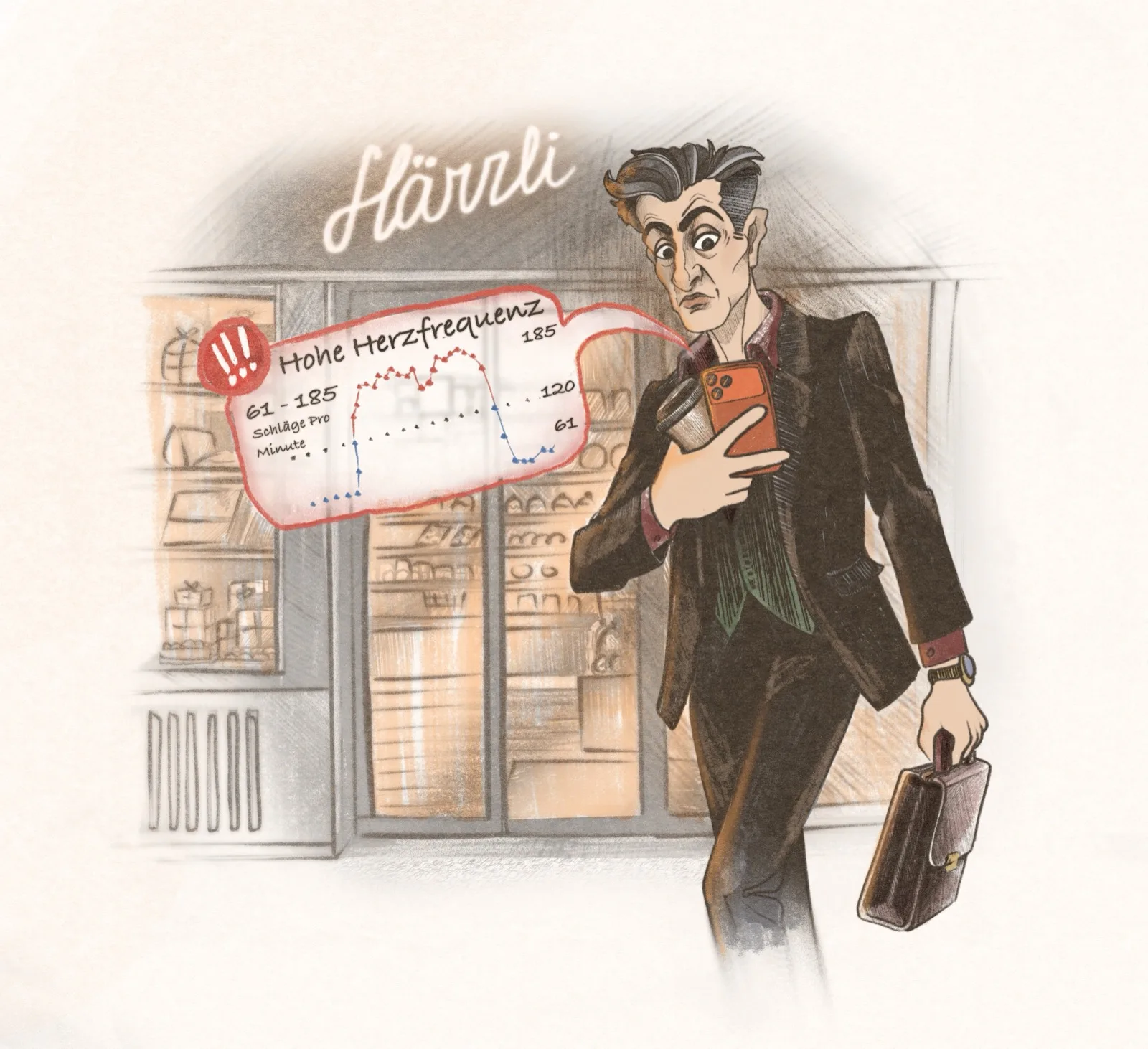
The mitral valve is the valve between the left atrium and the left ventricle. Once it no longer closes tightly, blood flows back into the atrium with every heartbeat and builds up towards the lungs. This is mitral valve regurgitation, the second most common heart valve defect requiring treatment. For a long time it stays silent. Then come breathlessness on exertion, exhaustion, sometimes palpitations. Here you can read what lies behind the diagnosis, from what point treatment becomes advisable and which procedures are available in Switzerland today.
What is mitral valve regurgitation, in brief?
In mitral valve regurgitation, the valve between the left atrium and the left ventricle no longer closes completely. During the ejection phase, part of the blood flows back into the atrium instead of entirely into the systemic circulation. The heart has to work harder and the pressure in the pulmonary vessels rises. Physicians distinguish two main forms. In the primary (organic) form the valve itself is altered, for example by a ruptured chorda tendinea or a mitral valve prolapse. In the secondary (functional) form the valve is essentially intact, but an enlarged or weakened ventricle pulls it apart, often after a heart attack or in heart failure. The degrees of severity range from mild through moderate to severe. A mild leak is found in a great many healthy people and usually remains harmless. Severe regurgitation, on the other hand, can shorten life expectancy considerably and belongs under regular cardiological surveillance. Which form is present and how badly the valve leaks decides the treatment, and the right moment for it.
How common is mitral valve regurgitation?
Mitral valve regurgitation is among the most widespread valve diseases of all. Its frequency rises steeply with age. Studies put the prevalence in the general population at around two to three percent, and at over ten percent in people over 75 [Nkomo 2006, Lancet]. That makes it the second most common heart valve defect requiring treatment in Europe, after aortic valve stenosis.
Because the valve often leaks unnoticed for years, the diagnosis is frequently made by chance, for instance when a typical heart murmur is picked up while listening with a stethoscope. With Switzerland's ageing population, the specialist societies expect the number of people affected to keep rising.
What symptoms does a leaking mitral valve cause?
In the early stages you often feel nothing at all. The heart compensates for the backflow for a while. Only when this compensation reaches its limit do symptoms appear. Typical are:
- shortness of breath on exertion, later also at rest
- rapid exhaustion and declining physical capacity
- palpitations or a racing heart, often due to atrial fibrillation
- fluid retention in the legs
- a dry cough at night or breathlessness when lying down
A rare, dramatic special form is acute severe mitral valve regurgitation. It arises, for example, from a sudden chordal rupture during a heart attack or from an infection of the heart valve (endocarditis). Here every hour counts, and immediate treatment is usually unavoidable.
What are the causes?
The triggers differ according to the form. In primary mitral valve regurgitation the change lies in the valve itself:
- degenerative changes with calcification in older age
- mitral valve prolapse due to a congenital connective tissue weakness
- rupture or overstretching of the chordae tendineae
- inflammation of the inner lining of the heart (endocarditis)
- rheumatic fever as a late consequence of a streptococcal infection
In the secondary form the valve is anatomically largely normal. A diseased ventricle distorts the supporting apparatus. The main causes are a previous heart attack, coronary heart disease and dilated cardiomyopathy, in which the left ventricle widens.
The primary form can hardly be prevented. In the secondary form, everything that protects the heart as a whole helps: exercise, a healthy weight, stopping smoking, blood pressure and blood sugar under control. Anyone who has their coronary heart disease treated also lowers the risk of the mitral valve becoming leaky.
How is the diagnosis made?
The most important tool is cardiac ultrasound. Transthoracic echocardiography through the chest wall confirms the diagnosis in most cases, shows the degree of severity and gives initial clues to the cause. From the measurements and your symptoms it follows whether and when an intervention makes sense.
Once treatment is under consideration, transoesophageal echocardiography (the "swallow echo", or TOE) almost always follows. Via the oesophagus the probe comes very close to the valve and delivers a precise image. This allows an assessment of whether the valve should be repaired or replaced, and whether open surgery or a catheter procedure is the better fit. In addition, a resting and a 24-hour ECG are used to look for rhythm disturbances, along with an exercise ECG.
From what point is treatment needed?
The right timing is decisive and belongs in experienced hands. In primary (degenerative) mitral valve regurgitation, the European guidelines recommend surgery as soon as the valve leaks severely and symptoms are present. Even without symptoms, an intervention can be indicated when the left ventricle begins to give way: at an ejection fraction of 60 percent or less, or an end-systolic ventricular diameter of 40 millimetres or more [ESC/EACTS 2021, Eur Heart J]. These thresholds sound technical, but they mark the moment at which waiting becomes more dangerous than the intervention.
With a degenerative valve, surgical repair is preferable to valve replacement wherever the anatomy permits. A repaired native valve holds up very well in the long term, protects against valve-related complications and is associated with a survival advantage that grows over the years [Lazam 2017, Circulation].
In secondary mitral valve regurgitation, consistent drug therapy for heart failure comes first. If symptoms persist regardless, the catheter procedure increasingly comes into play.
What treatments are available?
Three routes are available today, often in combination:
- Medication. Drugs treat the consequences of the leak and the underlying heart failure. In the secondary form they are the basis of every further decision.
- Surgery. Through the opened or minimally invasively accessed chest, the valve is repaired or replaced. With a degenerative valve, repair is the standard.
- Catheter procedure (TEER / MitraClip). Via a vein in the groin, a small clip is brought to the leaking spot and the valve leaflets are joined together at that point. The chest stays closed and the hospital stay is usually shorter.
The most important study on the MitraClip in secondary regurgitation is COAPT. In heart failure patients who remained symptomatic despite optimal medication, the procedure lowered mortality over two years from 46.1 to 29.1 percent and markedly reduced the number of heart failure hospitalisations [Stone 2018, N Engl J Med]. On the basis of these data, the European guideline has since given the procedure a high rating for selected patients with secondary regurgitation [ESC/EACTS 2025, Eur Heart J].
What is the prognosis?
With mild mitral valve regurgitation and no other heart disease, life expectancy is as a rule normal. Severe untreated regurgitation, on the other hand, places a permanent strain on the heart and can shorten life expectancy considerably.
No intervention is without risk, and neither is waiting. When the risk of waiting outweighs that of treatment, we at Dein Team Herzzentrum advise the intervention. It is precisely this weighing-up, supported by regular ultrasound checks, that determines the right moment.
Frequently asked questions about mitral valve regurgitation
Is mild mitral valve regurgitation dangerous? In most cases, no. A minor leak is found in many healthy people and often stays stable for a lifetime. What matters is that your heart is checked regularly by ultrasound, so that any deterioration is noticed early.
Does a leaking mitral valve always have to be operated on? No. Mild and moderate forms are usually only monitored. Treatment becomes necessary chiefly with severe leakage, when symptoms appear or the left ventricle measurably begins to give way.
What is the difference between the MitraClip and surgery? In surgery, the valve is repaired or replaced through the chest. With the MitraClip, a catheter travels to the heart via the groin and a small clip joins the leaflets together. The catheter procedure is gentler and is particularly suitable for people at high surgical risk.
Can I do sport with mitral valve regurgitation? With a mild leak, exercise is usually possible without restriction and is even desirable. At higher degrees of severity, your exercise profile should be assessed by a cardiologist. An exercise ECG helps to determine your individual limit.
Can mitral valve regurgitation be prevented? The primary form, which originates in the valve itself, hardly. The secondary form, yes: anyone who keeps blood pressure, weight, blood sugar and cholesterol under control, does not smoke and stays active protects their heart, and with it the valve.
How quickly does mitral valve regurgitation progress? The course varies greatly and is hard to predict. Some valves stay stable for years, others deteriorate rapidly. That is why regular ultrasound checks are so important: they detect a deterioration before it becomes dangerous.