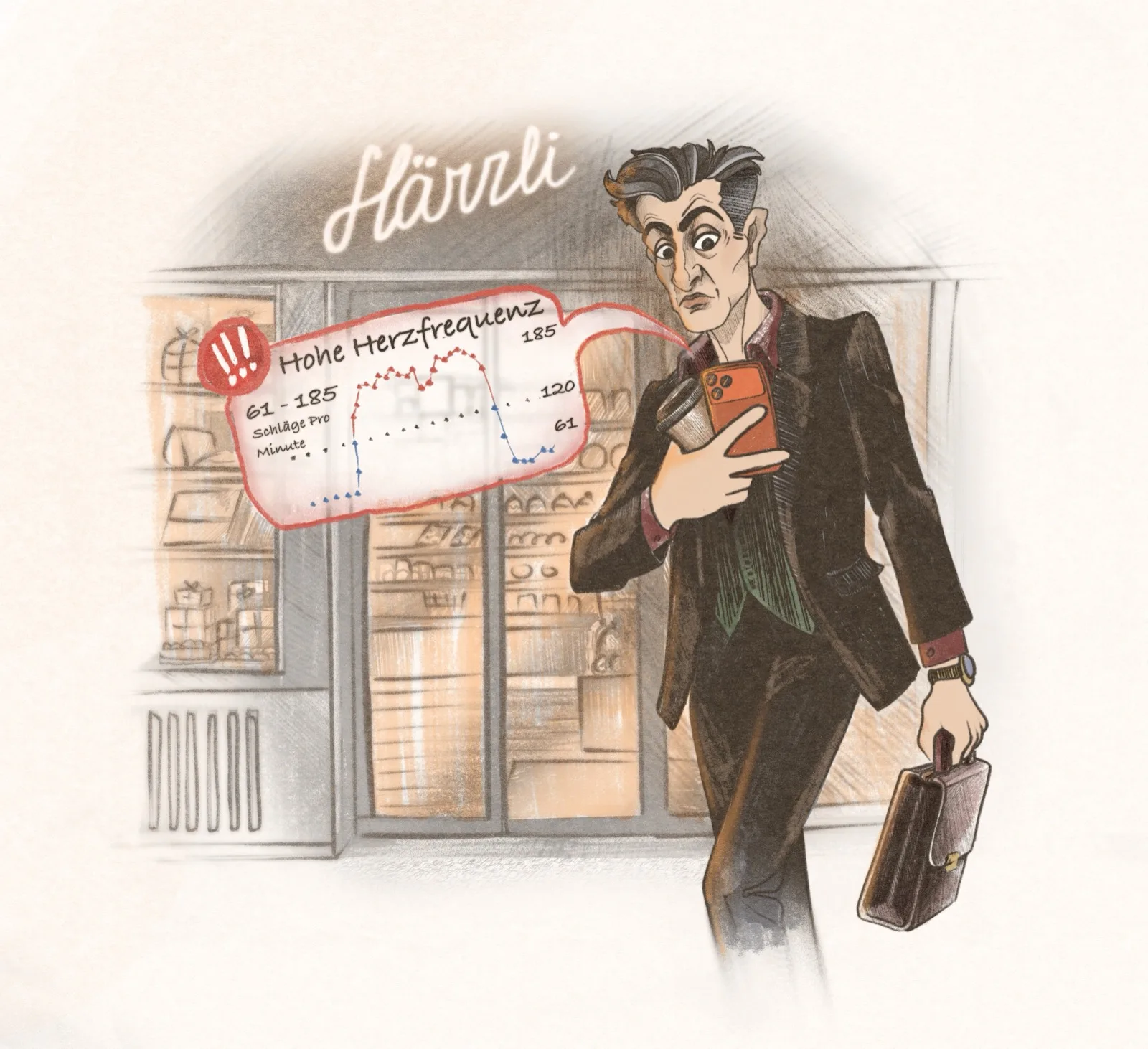
Coronary heart disease (CHD) is the leading cause of death in Switzerland. Every year, around 30,000 people here suffer an acute coronary event, meaning a heart attack or angina pectoris [Schweizerische Herzstiftung 2025]. The disease develops over years, often for a long time without any symptoms. That is precisely what makes it treacherous. If you know the risk factors and warning signs, you can act early. And with CHD, acting early changes the course of the disease decisively.
What is coronary heart disease, in brief?
In coronary heart disease, the coronary arteries become narrowed. These are the vessels that supply the heart muscle with oxygen-rich blood. The cause is deposits of cholesterol, connective tissue, calcium and inflammatory cells, known as plaques. This process is called atherosclerosis and runs over many years. As long as the narrowing remains slight, you usually notice nothing. Once the vessel becomes more severely constricted, the heart muscle receives too little oxygen under exertion. You feel this as pressure or tightness in the chest, often during physical exertion: typical angina pectoris. If a plaque ruptures and suddenly blocks the vessel completely, there is a risk of a heart attack with permanent damage to the heart muscle. The 2024 ESC guideline groups the stable forms of the disease under the term chronic coronary syndrome and stresses that the condition remains a dynamic process that changes over time [ESC 2024, Eur Heart J]. That is exactly why it needs regular monitoring. It can be treated at every stage.
Which risk factors drive CHD?
CHD arises from the interplay of several factors. Some cannot be changed, many can.
Not modifiable:
- Family history, particularly if parents or siblings developed the disease before the age of 55 (men) or 65 (women)
- Increasing age
- Sex: men develop the disease around ten years earlier on average, since female hormones offer a degree of protection until the menopause
Modifiable:
- Smoking
- High blood pressure
- Elevated LDL cholesterol
- Diabetes mellitus
- Excess weight, especially around the abdomen
- Lack of physical activity
- Persistent stress
Smoking weighs heaviest. A meta-analysis of 20 studies in people with existing coronary heart disease showed that those who quit smoking reduce their risk of death by around a third compared with those who continue (pooled risk ratio 0.64) [Critchley & Capewell 2003, JAMA]. This risk reduction is in the same order of magnitude as effective medication. Part of the excess risk disappears within the first two years after the last cigarette.
Symptoms: what you should watch for
In its early stage, CHD is frequently silent. The leading symptom of advanced disease is angina pectoris.
Typical signs are:
- Pressure or tightness behind the breastbone, often described as a weight on the chest
- Radiation into the left arm, both arms, neck, jaw, back or upper abdomen
- Accompanying shortness of breath, sweating, nausea, anxiety
The distinction between the stable and the unstable form matters. Stable angina pectoris occurs with predictable exertion, eases at rest and improves with nitro spray. Unstable angina pectoris appears even at rest or with the slightest effort, worsens rapidly and barely responds to nitro. It can be the harbinger of a heart attack.
Women often report less clear-cut signs: fatigue, nausea, breathlessness or back pain without the classic chest pain. This, too, needs to be taken seriously.
In an emergency: dial 144
If chest pain occurs at rest, lasts longer than a few minutes, or is joined by shortness of breath, cold sweat and a fear of dying, every minute counts. In Switzerland, you then call the emergency medical number 144 immediately and stay on the line until help arrives [Schweizerische Herzstiftung 2025]. Do not get behind the wheel yourself.
How is CHD diagnosed?
The work-up proceeds step by step and is guided by the pre-test probability, meaning how likely a relevant narrowing is based on your symptoms and risk profile.
| Step | Examination | What it shows |
|---|---|---|
| Baseline | Medical history, physical examination, resting ECG | Symptom pattern, risk factors, previous heart attacks |
| Functional test | Exercise ECG, stress echocardiography | Blood flow under exertion |
| Imaging | Echocardiography, myocardial scintigraphy | Pumping function, reduced blood flow |
| Anatomy | CT coronary angiography | Narrowings and calcifications directly visible |
| Gold standard | Cardiac catheterisation (coronary angiography) | Precise depiction, often direct treatment |
For a pre-test probability between 5 and 50 percent, the 2024 ESC guideline recommends CT coronary angiography as the preferred first imaging method [ESC 2024, Eur Heart J]. It requires no puncture of an artery and reliably rules out relevant CHD. Cardiac catheterisation remains the most precise test and has the advantage that a narrowing found there can often be treated in the same session.
What treatment options are there?
Therapy pursues two goals: relieving symptoms and lowering the risk of heart attack and death. It rests on three pillars.
1. Medication. It forms the basis of every CHD treatment.
- Antiplatelet agents such as aspirin (ASA) prevent blood clots
- Statins lower LDL cholesterol and stabilise the plaques. The 2024 ESC guideline sets an LDL target below 1.4 mmol/l (below 55 mg/dl) and at least a halving of the baseline value (recommendation class IA). If a high-dose statin is not enough, ezetimibe and, where necessary, a PCSK9 inhibitor are added [ESC 2024, Eur Heart J]
- Beta blockers lower heart rate and oxygen demand
- ACE inhibitors protect the heart and kidneys, particularly in diabetes
- Nitrates widen the vessels and provide acute relief from angina
2. Catheter treatment (PCI). Via the artery in the wrist or groin, the narrowing is widened with a balloon and held open with a drug-eluting stent. In an acute heart attack, rapid PCI is life-saving.
3. Bypass surgery (CABG). In narrowing of the left main stem, complex multivessel disease or diabetes with extensive findings, the surgeon reroutes the blood around the narrowings using the body's own vessels.
When should a vessel be opened, and when is medication enough? The large ISCHEMIA trial in 5,179 patients with stable CHD and a moderate to severe reduction in blood flow found no survival advantage over a good three years for an early catheter or bypass strategy compared with consistent medical therapy [Maron et al. 2020, NEJM]. With stable symptoms, it is therefore worth weighing the options carefully. In acute coronary syndrome, by contrast, rapid revascularisation is clearly superior. At Dein Team Herzzentrum, we discuss this decision with you individually and make it together, openly.
What you can do yourself
No tablet replaces a heart-healthy daily life. The most effective levers are in your hands.
- Stopping smoking. The single most effective measure of all (see above).
- Diet. A Mediterranean diet with plenty of vegetables, wholegrains, pulses, fish and olive oil. Little saturated fat, salt and sugar.
- Exercise. Around 150 minutes of moderate endurance activity per week, such as brisk walking, cycling or swimming. With known CHD, agree the intensity with your cardiologist.
- Weight and waist circumference. Keep an eye on both (men under 94 cm, women under 80 cm).
- Stress. Reduce it, get enough sleep, maintain social contacts.
Frequently asked questions about coronary heart disease
Can CHD be cured? Atherosclerosis itself cannot be reversed. You can, however, slow its progression and in favourable cases even partially stabilise it. With consistent therapy and a heart-healthy lifestyle, most people affected lead an active life with good quality of life.
How do I recognise CHD early? In the early stage, there are often no symptoms. Watch for pressure or tightness in the chest under exertion, declining exercise capacity or unusual shortness of breath. If you have risk factors such as smoking, high blood pressure, high cholesterol or a family history, a cardiological assessment is worthwhile before symptoms appear.
Do I always need a stent? No. In stable CHD without acute danger, the ISCHEMIA trial showed that consistent medical therapy often protects against heart attack and death just as well as early catheter treatment [Maron et al. 2020, NEJM]. A stent primarily improves symptoms that persist despite medication, as well as the prognosis in certain high-risk situations and in acute heart attack.
How high may my cholesterol be? For people with confirmed CHD, the 2024 ESC guideline recommends an LDL cholesterol below 1.4 mmol/l (below 55 mg/dl) and at least a halving of the baseline value [ESC 2024, Eur Heart J]. The exact target depends on your individual overall risk and is something your physician should assess.
What do I do in the event of sudden chest pain? If chest pain persists at rest, radiates, or is accompanied by shortness of breath and cold sweat, dial 144 immediately in Switzerland. Stay calm, sit down with your upper body raised and wait for the ambulance. Do not drive yourself to hospital.
Who treats CHD in Zürich? The assessment and treatment of coronary heart disease belongs in the hands of a cardiologist. At Dein Team Herzzentrum in Zürich, we cover the entire chain from diagnostics through catheter treatment to follow-up care, at short notice and without detours. Appointments are possible without a referral.
This article is intended for your orientation and does not replace a consultation with a physician. If you have symptoms or several risk factors come together in your case, have your heart checked in person.