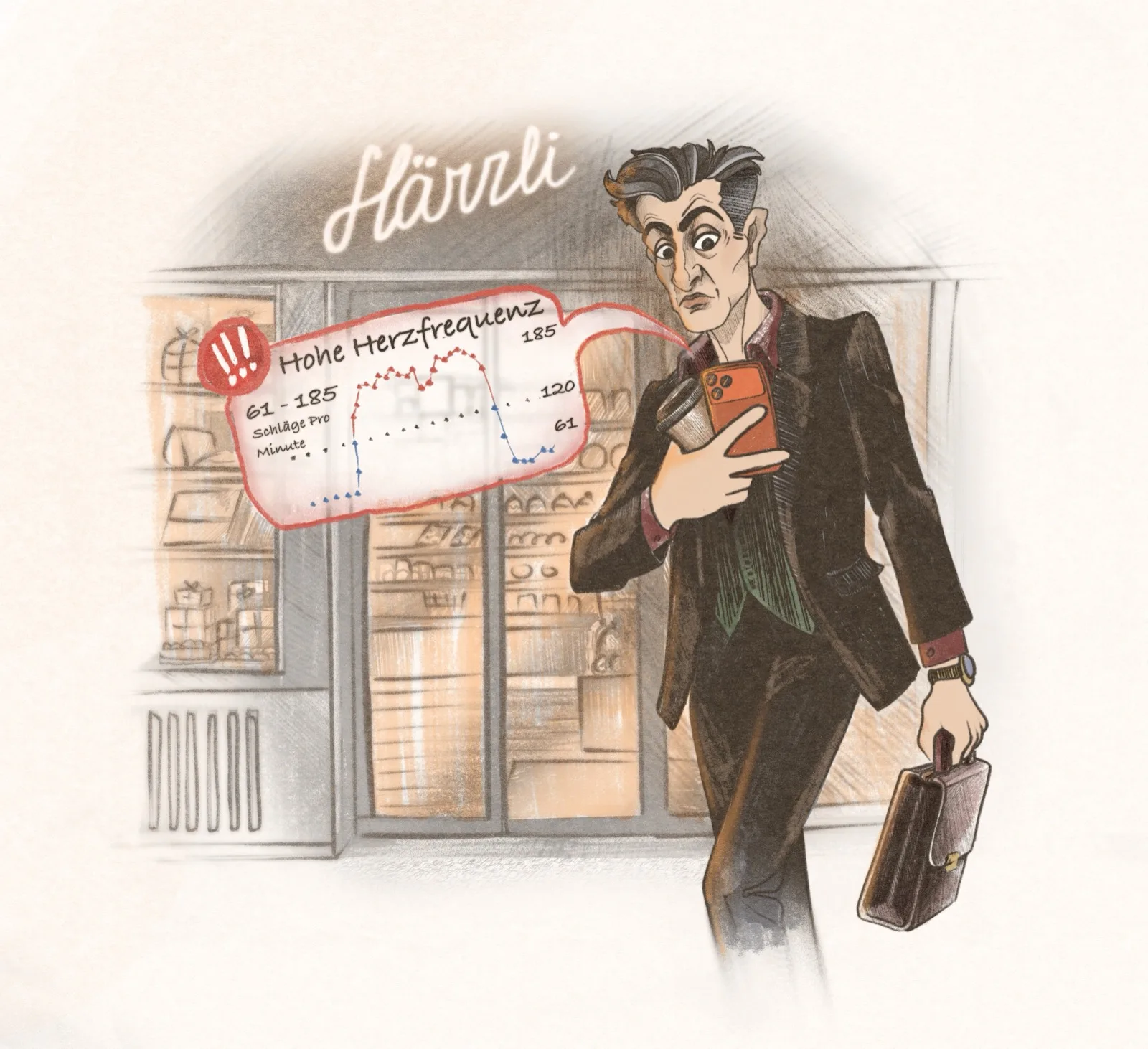
"Do I have to give up coffee because of my heart?" We hear this question in the consultation almost every day. The short answer reassures most people: for a healthy heart, moderate coffee is safe, and the data of recent years even point to a protective effect. The details are where it gets interesting. How you prepare your coffee, how much you drink and how quickly your body breaks down caffeine change the picture for your heart more than the cup itself.
How much coffee is good for the heart?
For most adults, three to five cups of coffee a day are associated with the lowest cardiovascular risk. A large analysis of 36 studies with over 1.2 million people shows a J-shaped curve: the risk falls with moderate consumption, reaches its lowest point at three to five cups daily, and even at high consumption does not rise above the level of non-drinkers [Ding M et al., Circulation 2014]. Preparation is decisive. Filter coffee is considered heart-friendly because the filter holds back the cholesterol-raising substances cafestol and kahweol [Schweizerische Herzstiftung 2024]. Unfiltered coffee from a French press, Turkish-style coffee or boiled coffee lets these diterpenes into the cup, and they raise LDL cholesterol measurably. Caffeine raises blood pressure in the short term, but if you drink regularly, you get used to it. As for heart rhythm, on current evidence there is no cause for concern, even for people with atrial fibrillation. If you sleep poorly or get jittery, you break down caffeine more slowly. Then it is worth checking the amount.
Filter or French press: why the preparation changes your cholesterol
Coffee is more than caffeine. The bean also contains two fat-soluble substances, cafestol and kahweol, grouped together as diterpenes. In the liver, these diterpenes slow the breakdown of LDL cholesterol, and the level in the blood rises [Schweizerische Herzstiftung 2024]. Precisely these substances get caught in the paper filter.
The preparation method decides how much of them ends up in your cup:
- High: boiled coffee, Turkish and Greek coffee, French press (coffee in direct contact with the grounds)
- Medium: espresso and espresso-based drinks
- Very low: filter coffee with a paper filter, instant coffee
The Swiss Heart Foundation puts it plainly: you get the heart-protective effect above all with filter coffee or instant coffee, because here the cholesterol-raising substances are largely removed [Schweizerische Herzstiftung 2024]. If you drink several cups of unfiltered coffee a day and already have raised blood lipids, switching to a paper filter is something you can do for your LDL. In my consultation, this question is part of every cholesterol discussion, because it costs nothing and can be put into practice straight away.
Coffee and blood pressure: high in the short term, relaxed in the long term
Caffeine has a sympathomimetic effect, so it can raise blood pressure briefly. In people who rarely drink coffee, a single cup raises the systolic pressure acutely and measurably. In habitual drinkers this effect is considerably smaller or absent altogether, because the body gets used to the caffeine [Zimmermann-Viehoff F et al., 2016]. The body develops a tolerance.
Viewed over the years, the picture is relaxed. One to two cups a day do not increase the risk of newly developing hypertension, and with higher regular consumption, observational data tend to show a slightly reduced risk [Ding M et al., Circulation 2014]. For people with well-controlled high blood pressure, moderate coffee is usually not a problem. If your blood pressure fluctuates or has only just been diagnosed, measure it over a few days with and without your usual cup. That way you see your own reaction in black and white.
Does coffee trigger atrial fibrillation? The most persistent myth
For decades the rule was: anyone prone to skipped heartbeats or atrial fibrillation should avoid coffee. Current data no longer support this warning.
For each additional cup of coffee per day, the risk of atrial fibrillation fell by around two percent. A trigger looks different.
A dose-response meta-analysis of ten prospective studies with over 30,000 atrial fibrillation events found no indication that coffee promotes atrial fibrillation. On the contrary, a slightly protective trend emerged [Cao Y et al., Front Cardiovasc Med 2022]. The CRAVE study went a step more direct. Here, 100 healthy adults wore an ECG device for two weeks and, on randomly assigned days, either drank coffee or abstained. On coffee days there were no more atrial extrasystoles, which are precisely the precursors associated with atrial fibrillation. What was observed on coffee days were somewhat more ventricular extrasystoles, more steps and slightly less sleep [Marcus GM et al., NEJM 2023]. The Swiss Heart Foundation also sees no proven link between caffeine and an increased risk of atrial fibrillation [Schweizerische Herzstiftung 2024]. If you notice for yourself that the third cup sets off skipped beats, you may still cut back. Your own perception counts, even when the statistics are reassuring.
Coffee and type 2 diabetes: an underrated plus
When it comes to metabolism, coffee is often overlooked, yet the evidence here is particularly solid. A meta-analysis of 28 prospective studies with over 1.1 million people found that each additional cup per day lowered the risk of type 2 diabetes by around six percent [Ding M et al., Diabetes Care 2014]. The effect appeared equally for caffeinated and decaffeinated coffee. This suggests that the polyphenols and other constituents of the bean also play a part here, beyond the caffeine. For the cardiovascular system this matters, because type 2 diabetes is one of the strongest drivers of coronary heart disease. Anyone who prevents it also protects their heart indirectly.
Why coffee affects you differently: caffeine, genes and pregnancy
That some people tolerate an espresso in the evening while others lie awake after the afternoon cup has a genetic background. The enzyme CYP1A2 breaks down caffeine, and a common gene variant makes people slow metabolisers. In a case-control study, high coffee consumption was associated with an increased risk of heart attack only in slow metabolisers, and not in fast metabolisers [Cornelis MC et al., JAMA 2006]. You do not need a genetic test for this. Sleep, palpitations and inner restlessness are useful everyday signals of whether you belong more to the slow type.
Pregnancy has its own rules. Professional societies consider up to 200 milligrams of caffeine per day, roughly one to two cups of coffee, to be acceptable [ACOG 2010]. During pregnancy the body breaks down caffeine considerably more slowly, so the effect lasts longer. If you are breastfeeding, have a heart condition or take medication, the right amount is best discussed directly with your treating physician.
Frequently asked questions
Is coffee bad for the heart? Not for most healthy adults. In large studies, three to five cups a day are associated with the lowest cardiovascular risk [Ding M et al., Circulation 2014]. More important than the quantity is often the preparation and your personal tolerance.
Which coffee is healthiest for the heart? Filter coffee with a paper filter, because the filter holds back the cholesterol-raising diterpenes [Schweizerische Herzstiftung 2024]. Instant coffee is also favourable. French press, Turkish-style coffee and boiled coffee contain more of these substances.
Does coffee raise blood pressure permanently? In the short term caffeine can raise the pressure, above all in occasional drinkers. With regular consumption the body adapts, and in the long term the risk of hypertension does not rise with moderate consumption [Zimmermann-Viehoff F et al., 2016].
Can I drink coffee if I have atrial fibrillation? On current evidence, there is nothing to say against moderate coffee with atrial fibrillation. The CRAVE study found no increase in atrial extrasystoles on coffee days [Marcus GM et al., NEJM 2023]. Still, discuss your individual situation with your cardiologist.
Does coffee help against diabetes? Observational data show a type 2 diabetes risk lowered by around six percent per cup per day, also for decaffeinated coffee [Ding M et al., Diabetes Care 2014]. Coffee does not replace a healthy lifestyle. It does fit into one well.
How much caffeine is allowed in pregnancy? Professional societies name up to 200 milligrams per day as acceptable, so about one to two cups [ACOG 2010]. Since caffeine is broken down more slowly in pregnancy, an individual discussion is worthwhile.
Why do I tolerate coffee less well than others? The enzyme CYP1A2 determines how quickly you break down caffeine. Slow metabolisers react more sensitively [Cornelis MC et al., JAMA 2006]. Sleep problems and palpitations after a cup are good reasons to check the amount.