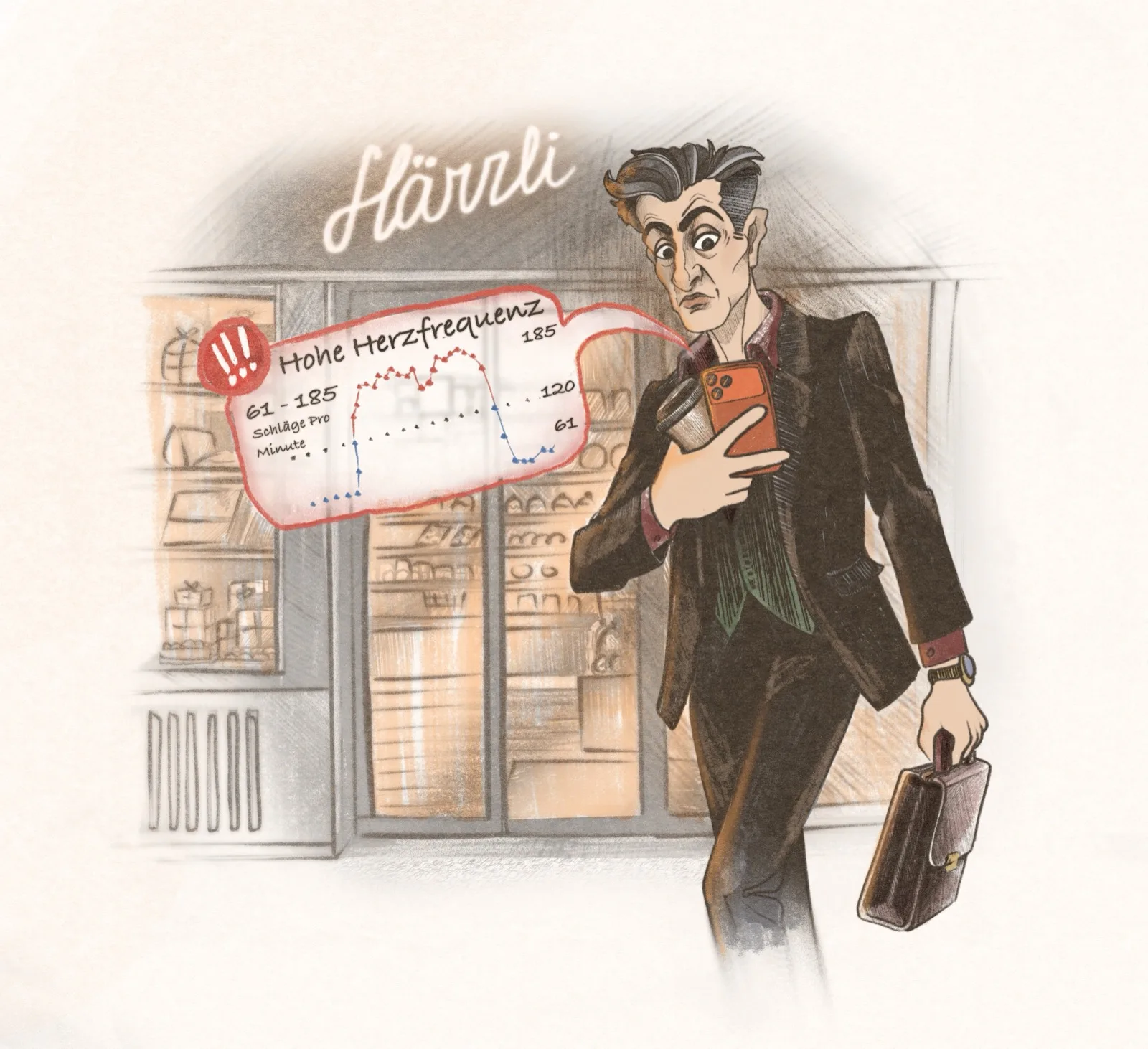
When heart disease is already known, persistent tiredness, declining performance and breathlessness on light exertion are often attributed to the underlying condition. Often, however, a second and readily treatable factor sits alongside it: iron deficiency, with or without accompanying anaemia. Up to half of all patients with chronic heart failure carry this deficiency, often without a markedly reduced haemoglobin [Klip IT et al., Am Heart J 2013]. The deficiency is clinically relevant: an independent risk factor with a treatment option of its own.
What iron deficiency means for the heart patient and what the current evidence says
Why iron deficiency puts additional strain on a weakened heart
The heart muscle is a high-performance organ with a high density of mitochondria. Iron acts there on oxygen transport via haemoglobin, and it also acts directly inside the cardiomyocytes as a component of myoglobin, the respiratory chain and several iron-containing enzymes. When iron is lacking, both the oxygen transport capacity of the blood and the cellular energy production in the heart muscle itself decline.
In an already weakened heart this double burden weighs more heavily. The compensatory rise in heart rate increases myocardial oxygen demand and can aggravate the symptoms of heart failure or coronary artery disease. In the international pooled analysis by Klip and colleagues, the prevalence of iron deficiency was 50 percent among outpatients with chronic heart failure, and higher still among inpatients with acute decompensation [Klip IT et al., Am Heart J 2013]. Jankowska and colleagues documented the prognostic significance in 2010: in 546 patients with systolic heart failure, iron deficiency was an independent predictor of all-cause mortality and of the combined endpoint of death and heart transplantation, independently of haemoglobin level and NYHA class [Jankowska EA et al., Eur Heart J 2010].
Diagnosis: ferritin and transferrin saturation, because the blood count alone is not enough
Measuring only haemoglobin and mean corpuscular volume (MCV) misses iron deficiency without anaemia. In patients with heart failure this constellation is common: haemoglobin in the lower normal range, MCV unremarkable, yet empty stores with reduced transport capacity.
The 2021 ESC guideline defines iron deficiency in heart failure with two thresholds: absolute deficiency at a ferritin below 100 ng/ml, functional deficiency at a ferritin between 100 and 299 ng/ml together with a transferrin saturation below 20 percent [McDonagh TA et al., Eur Heart J 2021]. These values deliberately differ from the classic cut-offs for iron deficiency in the general population, because in heart failure a chronic inflammatory milieu raises ferritin as an acute-phase protein and can thereby mask a genuine depletion of the stores. An isolated ferritin measurement without transferrin saturation is therefore insufficient in cardiac patients.
- Symptoms that should raise the question of iron deficiency when heart disease is known
- Increasing tiredness without any new cardiac deterioration on echo
- Exertional dyspnoea despite optimised heart failure medication
- Reduced capacity in the 6-minute walk test or in everyday life
- Difficulty concentrating, restless legs symptoms
- Pallor, brittle nails, hair loss (late signs)
Risk groups with a higher likelihood
- Chronic heart failure (HFrEF and HFpEF)
- After acute heart failure decompensation
- Coronary artery disease with comorbidities
- Chronic kidney disease alongside the cardiopathy
- Women before the menopause with a cardiac diagnosis
- Patients on long-term anticoagulation or aspirin
Treatment: oral substitution, intravenous iron and the question of indication
Oral iron substitution remains the first line for stable, non-cardiac patients with an uncomplicated deficiency. In heart patients it often does not work well enough, for several reasons: enteral absorption is impaired in the chronic inflammatory milieu, gastrointestinal side effects limit adherence, and the randomised IRONOUT-HF trial showed in 225 patients with HFrEF that oral iron over 16 weeks measurably improved neither peak oxygen uptake nor 6-minute walk distance [Lewis GD et al., JAMA 2017].
Structured iron work-up for a cardiac diagnosis
In the heart failure clinic at Dein Team Herzzentrum we assess ferritin, transferrin saturation and CRP together with the current echo and laboratory findings. Internal medicine and cardiology under one roof.
Book an appointment in the clinicFor symptomatic heart failure patients with confirmed deficiency, intravenous substitution with ferric carboxymaltose has become established as the superior option. FAIR-HF (Anker and colleagues, NEJM 2009) showed in 459 outpatients with HFrEF in NYHA class II to III that intravenous iron significantly improves self-assessed symptoms (Patient Global Assessment) and NYHA class [Anker SD et al., NEJM 2009]. CONFIRM-HF (Ponikowski and colleagues, Eur Heart J 2015) confirmed these findings in 304 patients over 52 weeks and documented a significant improvement in 6-minute walk distance of 33 metres on average [Ponikowski P et al., Eur Heart J 2015]. AFFIRM-AHF (Ponikowski and colleagues, Lancet 2020), a randomised multicentre trial in 1132 patients after acute decompensation, showed a reduction in heart-failure-related rehospitalisations, though without a significant effect on cardiovascular mortality [Ponikowski P et al., Lancet 2020]. The more recent HEART-FID trial (Mentz and colleagues, NEJM 2023) formally missed its combined endpoint of death, heart failure hospitalisations and 6-minute walk distance in 3065 patients; the direction of effect was consistent, but the effect size was smaller than initially assumed [Mentz RJ et al., NEJM 2023].
On this evidence base, the ESC in its 2023 Focused Update recommends intravenous iron substitution with ferric carboxymaltose or ferric derisomaltose in symptomatic heart failure with reduced or mildly reduced ejection fraction (LVEF ≤50 percent) and confirmed iron deficiency as a Class IIa recommendation to improve symptoms and quality of life, and after acute decompensation to reduce the rehospitalisation rate [McDonagh TA et al., Eur Heart J 2023]. Substitution is typically given as one or two infusions, dosed according to haemoglobin and body weight; the stores are usually replenished within a few weeks.
Who benefits, who does not, and when a cardiological co-assessment makes sense
Not every tiredness in known heart disease can be traced back to iron deficiency, and not every confirmed iron deficiency justifies intravenous therapy. The indication is guided by three axes: symptoms (NYHA class, exercise capacity), laboratory constellation (ferritin, TSAT, CRP) and underlying disease (HFrEF, HFmrEF, HFpEF, coronary artery disease, kidney function).
A cardiological co-assessment makes sense when symptoms persist despite iron substitution by the internist, when echocardiography shows a reduced or mildly reduced ejection fraction, or when an acute decompensation occurred in the recent history. Here the patient benefits from a joint assessment by internal medicine and cardiology, with coordinated adjustment of the basic heart failure therapy (beta-blocker, ACE inhibitor or ARNI, MRA, SGLT2 inhibitor) and of the iron strategy. This interface is why the DTL practice (internal medicine) and the DTH Herzzentrum (cardiology) work closely together on cardiac patients with iron deficiency.
Consultation at Dein Team Herzzentrum
Iron status, echo and heart failure therapy assessed in a structured way. First contact without a referral. Appointment usually within a week. For acute breathlessness at rest or persistent chest pressure, dial 144, the Swiss emergency number.
Book an appointment:::faq
Is a normal blood count enough to rule out iron deficiency in heart failure?
No. In patients with heart failure, the deficiency typically appears before haemoglobin or MCV become abnormal. A complete assessment also includes ferritin and transferrin saturation, ideally with CRP to assess the inflammatory status.
Which ferritin and TSAT values count as deficiency in heart failure?
The 2021 ESC guideline defines iron deficiency in heart failure as ferritin below 100 ng/ml (absolute deficiency) or ferritin between 100 and 299 ng/ml together with a transferrin saturation below 20 percent (functional deficiency) [McDonagh TA et al., Eur Heart J 2021].
Why is intravenous iron often chosen over tablets in heart patients?
In chronic heart failure with a chronic inflammatory milieu, enteral iron absorption is reduced, and oral iron is often poorly tolerated because of gastrointestinal side effects. The randomised IRONOUT-HF trial found no effect of oral iron on exercise capacity in HFrEF [Lewis GD et al., JAMA 2017]; intravenous ferric carboxymaltose, by contrast, improved symptoms and 6-minute walk distance in FAIR-HF and CONFIRM-HF [Anker SD et al., NEJM 2009; Ponikowski P et al., Eur Heart J 2015].
How quickly does intravenous iron substitution work?
The randomised trials typically document a measurable improvement in symptoms and exercise capacity within four to twelve weeks of the first infusion. The stores are usually replenished after one or two infusions; a check of the iron values is indicated three to six months later.
Does intravenous iron substitution lower mortality in heart failure?
The randomised trials consistently show an improvement in symptoms and exercise capacity. AFFIRM-AHF reduced heart failure hospitalisations after acute decompensation, without a significant effect on cardiovascular mortality [Ponikowski P et al., Lancet 2020]. HEART-FID formally missed its primary combined endpoint [Mentz RJ et al., NEJM 2023]. The benefit for quality of life and hospitalisation is consistently documented; a clearly proven effect on mortality is not.
:::
About the authors. This article was produced in a cross-brand collaboration. Author: Prof. Dr. C. K. Fritz M.Sc., Physician Associate for General Internal Medicine, Pain Medicine, Practice Lead of Dein Team fürs Leben (DTL internal medicine GP practice, Zürich). An internal medicine perspective on a cardiological comorbidity. Medically reviewed by Prof. Dr. Steffen Gloekler, FMH Cardiology, Interventional Cardiology, FESC, MBA, Dein Team Herzzentrum Zürich. The founding-pair cross-review between DTL (internal medicine) and DTH (cardiology) secures professional depth in both domains on cardio-internal topics.