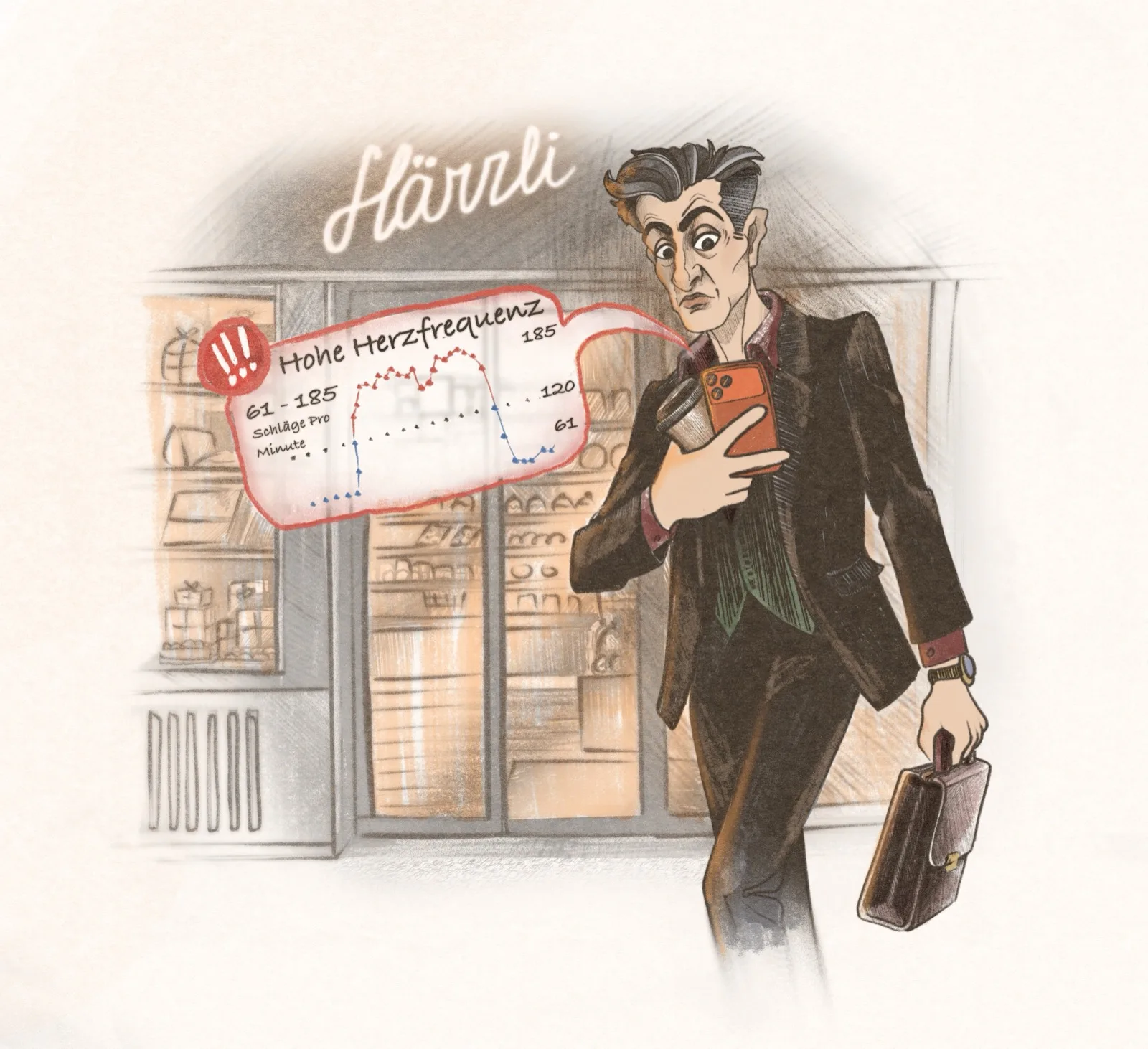
Your pulse skips, your heart races for a few minutes without any obvious reason, or your smartwatch reports an irregular rhythm. For many people, that is exactly how atrial fibrillation feels: inconspicuous, fleeting, easy to miss. It is the most common sustained cardiac arrhythmia, and around 100,000 people in Switzerland live with it [Swiss Heart Foundation 2025]. The real risk does not lie in the skipped beats. It lies in the stroke, which becomes considerably more likely if the condition goes untreated.
Atrial fibrillation in brief
In atrial fibrillation, the two atria of the heart fire off a chaotic electrical tangle instead of an orderly beat. The sinus node, your natural pacemaker, loses control. The atria no longer pump in a coordinated way; they merely quiver. Blood in the left atrial appendage is no longer fully flushed out and can clot. If such a clot breaks loose, it can travel to the brain and block a vessel there [Swiss Heart Foundation 2025].
This is often felt as palpitations, a racing heart, dizziness, tiredness, pressure on the chest or shortness of breath. In some people, however, atrial fibrillation runs its course entirely without symptoms and is only discovered through an ECG or a wearable [ESC 2024, Eur Heart J]. A reliable diagnosis requires an ECG taken by a physician, because the typical irregular pattern without recognisable atrial activity can be demonstrated unambiguously there. At Dein Team Herzzentrum we confirm every suspicion raised by a wearable with a 12-lead ECG before we discuss treatment.
What forms are there?
The current ESC guideline classifies atrial fibrillation by its course over time [ESC 2024, Eur Heart J]:
| Form | What it means |
|---|---|
| First diagnosed | Detected for the first time, regardless of duration or symptoms |
| Paroxysmal | Comes and goes, ends on its own within seven days, usually within 24 hours |
| Persistent | Lasts longer than seven days or has to be actively returned to normal rhythm |
| Long-standing persistent | Has been present for more than twelve months, and rhythm control is still being pursued |
| Permanent | You and your treatment team decide together to stop trying to restore normal rhythm |
This classification is more than a label. The course over time helps determine how early and how consistently treatment is given. The paroxysmal form in particular often goes unnoticed for a long time, because the episodes are short and disappear on their own. If you collect the recordings from your wearable over several weeks, you often give us the first clue as to which of these categories your own atrial fibrillation falls into.
Why a wearable finding should be taken seriously
Many younger people now come to us via their smartwatch. That is a welcome development, because this is how silent episodes become visible in the first place. A single-lead ECG from a watch, however, is a pointer. It does not settle the question.
The evidence on this is solid. A meta-analysis of single-lead Apple Watch recordings showed a sensitivity of over 90 per cent when the tracings were interpreted by physicians, whereas the devices' automatic analysis performed considerably worse [Diagnostic Accuracy Meta-Analysis 2024, PMC]. The 12-lead ECG therefore remains the reference standard. An alert from your watch is a reason for a medical work-up. It is not a finished diagnosis.
In practical terms, this means: save the recording from your watch, note the date and time of the episodes, and bring both to your appointment. These records help us gauge how often and for how long your heart falls out of step. Sometimes a single 12-lead ECG is not enough, because the atrial fibrillation happens to be pausing at that moment. In that case we extend the work-up with a long-term ECG over 24 hours or longer, which records the episodes across your everyday life.
What promotes atrial fibrillation?
Atrial fibrillation rarely appears out of nowhere. In most cases, several factors act together, remodelling the atrial tissue over time and making it more electrically excitable. Age is the strongest of these: among people over 75, around 10 per cent are affected [Swiss Heart Foundation 2025].
Beyond that, further influences play a part, some of which can be changed:
- high blood pressure, which puts strain on the atria over years
- excess weight and untreated sleep apnoea
- an overactive thyroid
- high alcohol consumption, including occasional heavy drinking
- endurance sport at a very high weekly volume over many years
The last point often surprises physically active people. Moderate exercise protects the heart. Very intensive and very extensive endurance training over a long period, on the other hand, can raise the risk of atrial fibrillation. The ESC guideline therefore deliberately places the management of comorbidities and risk factors at the start of treatment [ESC 2024, Eur Heart J]. If you get blood pressure, weight and sleep under control, you influence your rhythm as well.
How is atrial fibrillation treated?
Treatment pursues two goals at once: lowering the risk of stroke and controlling the rhythm or the heart rate. The ESC summarises this approach under the term AF-CARE, which combines comorbidities, stroke prevention, symptom control and regular reassessment [ESC 2024, Eur Heart J].
For stroke prevention, cardiology uses the CHA₂DS₂-VA score. The 2024 guideline removed female sex as a separate criterion from the calculation in order to standardise the decision on anticoagulation [ESC 2024, Eur Heart J]. From a score of 2, oral anticoagulation is recommended; from a score of 1, it can be considered.
On rhythm, the evidence points towards early intervention. The EAST-AFNET 4 trial showed that consistent rhythm control within the first year after diagnosis made serious cardiovascular events less frequent than observation alone [Kirchhof 2020, N Engl J Med]. Medication and catheter ablation are available for this. In ablation, the sites in the atrium from which the faulty electrical impulses originate are deliberately scarred (ablated), usually around the pulmonary veins. If the main concern is to slow down an excessively high heart rate, rate-lowering medication is used. Which path suits you depends on the form, your symptoms and your comorbidities, and belongs in a consultation with a physician that brings together your wearable records and your personal risk.
Frequently asked questions
Is atrial fibrillation dangerous? The palpitations themselves are usually not life-threatening. What is dangerous is the increased risk of stroke that untreated atrial fibrillation brings with it [Swiss Heart Foundation 2025]. That is precisely why stroke prevention comes first in every treatment.
Can atrial fibrillation occur entirely without symptoms? Yes. Some of those affected feel nothing and only learn of it through an ECG or a wearable [ESC 2024, Eur Heart J]. Silent atrial fibrillation is no less harmful. It is simply discovered later.
Is a smartwatch enough for a diagnosis? No. A watch can raise a suspicion, and that is valuable. Atrial fibrillation is only confirmed by an ECG taken by a physician, because the devices' automatic analysis is too unreliable [Diagnostic Accuracy Meta-Analysis 2024, PMC].
I am young and sporty. Can it still affect me? The risk rises with age, and among people over 75 around 10 per cent are affected [Swiss Heart Foundation 2025]. Atrial fibrillation does occur in younger and physically active people too, however. Endurance sport at a very high volume over many years is one of the factors that can play a part. A wearable finding in a 38-year-old should therefore be taken just as seriously as one in a 70-year-old.
Will I have to take blood thinners for life? That depends on your individual risk, which is assessed using the CHA₂DS₂-VA score [ESC 2024, Eur Heart J]. At low risk, anticoagulation can be dispensed with; at higher risk, it protects you from a stroke.
When should I book an appointment? If your watch repeatedly reports an irregular rhythm, if you notice palpitations, dizziness or unexplained tiredness, or if atrial fibrillation runs in your family, a cardiological work-up is worthwhile. Sudden chest pain, shortness of breath or signs of a stroke are an emergency and belong in the emergency department immediately.
Atrial fibrillation can be treated well when it is detected early. Bring your wearable data with you, and together we will look at what your heart is really doing.