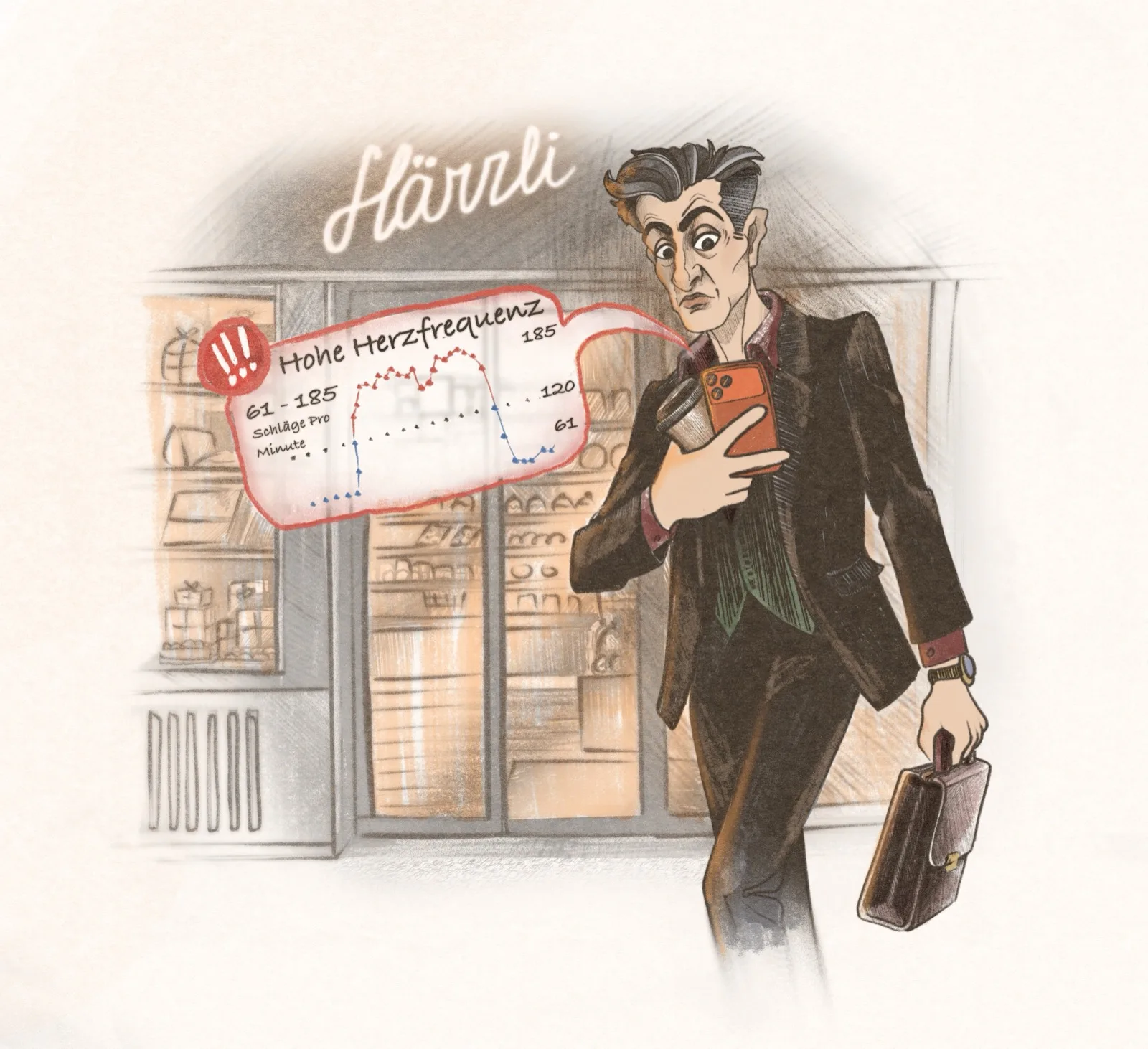
A brief stab on the left of the chest, and the thought of a heart attack is there at once. In most people the cause lies elsewhere: in the muscles, at the ribs, in the stomach or in a stressful phase of life. The danger comes with a very different type of pain. If you can tell the two apart, you gain time when it matters, and where the heart is concerned, time is the most valuable thing you have.
Classifying stabbing chest pain: harmless or an emergency?
A sharp, pinpoint pain that lasts only seconds, can be located precisely and appears when you breathe or make a particular movement has a harmless cause in most cases. Muscular tension and irritation of the rib cartilage are among the most frequent triggers of non-cardiac chest pain [AAFP 2021].
A threatening cardiac pain feels different. It is dull, pressing or burning, sits behind the breastbone and lasts longer than a few minutes. It often radiates into the arm, jaw, shoulder or back and is accompanied by breathlessness, cold sweat, nausea or intense anxiety [Schweizerische Herzstiftung 2025]. This pain does not ease at rest and tends to get worse with exertion. With this pattern, call emergency number 144 immediately. When in doubt, better to call once too often than once too late.
What happens in the body during stabbing chest pain?
The term stabbing chest pain describes a sensation rather than a diagnosis. The heart itself has hardly any receptors for sharp, pinpoint pain. A sharp stab that you can locate precisely therefore usually comes from the surrounding tissue: from the muscles of the chest wall, the junctions between ribs and cartilage, the oesophagus or the pleura.
Genuine pain from reduced blood flow to the heart muscle feels more diffuse. Patients describe it as pressure, tightness or a band around the chest, rarely as a stab. It is precisely this description that directs suspicion towards angina pectoris or a heart attack.
The distinction is made by taking the history, a detailed conversation about the nature, duration, triggers and accompanying symptoms. This is the first and most important step of any assessment. Only then is it clear which examinations make sense.
The two types of pain compared
| Feature | More likely harmless | Warning sign |
|---|---|---|
| Character | stabbing, sharp, pinpoint | dull, pressing, burning |
| Duration | seconds | longer than a few minutes |
| Location | can be pointed to exactly, often on the left | behind the breastbone, diffuse |
| Trigger | breathing, movement, pressure on the spot | physical or emotional strain |
| Radiation | none | arm, jaw, shoulder, back |
| Accompanying symptoms | usually none | breathlessness, sweating, nausea, anxiety |
| Behaviour at rest | often improves | persists or increases |
This table is no substitute for an examination. In a moment of uncertainty it helps you judge whether to observe or act.
Why women, older people and people with diabetes should take particular care
The classic picture of pressing pain behind the breastbone is far from universal. Women, older people and people with diabetes more often present with different symptoms: breathlessness alone, unusual tiredness, weakness, pressure in the upper abdomen or nausea, sometimes with no distinct chest pain at all [AHA 2016, Circulation].
These symptoms appear less dramatic and are therefore more easily underestimated, by patients and clinicians alike. The American Heart Association reports that women less often attribute warning signs to the heart and more often hesitate before seeking help. That costs valuable time [AHA 2016, Circulation]. If you belong to one of these groups and notice new, unexplained symptoms, take them seriously, even if they seem atypical.
Why every minute counts where the heart is concerned
In an acute heart attack, a clot blocks a coronary artery. The heart muscle beyond it is no longer supplied with blood and begins to die. The longer this state lasts, the greater the permanent damage.
The evidence is clear. A longer total ischaemic time, that is, the time from symptom onset to reopening of the vessel, is associated with higher mortality. In one analysis, in-hospital mortality was 4.5 percent with an ischaemic time of up to 120 minutes and 7.8 percent with more than 240 minutes [Egyptian Heart Journal 2021]. Every delay in reopening the vessel measurably increases the risk.
Cardiovascular diseases remain the most frequent cause of death in Switzerland and were responsible for around 27.5 percent of all deaths in 2022 [BFS 2023]. This figure is one more argument against waiting and seeing with a suspicious chest pain.
How we assess stabbing chest pain
When there is doubt that the pain is harmless, the team at Dein Team Herzzentrum proceeds in a structured way. The assessment follows a clear sequence.
- History and physical examination. The conversation about the nature and triggers of the symptoms, plus palpation of the chest wall, already narrows down many harmless causes.
- ECG. The electrocardiogram shows acute disturbances of blood flow and rhythm disorders.
- Blood test. The troponin level helps to confirm or rule out a heart attack.
- Echocardiography. The cardiac ultrasound assesses pumping function and heart valves. The 2024 ESC guideline recommends resting echocardiography as a fixed part of the assessment when coronary heart disease is suspected [ESC 2024, Eur Heart J].
- Further tests. Exercise ECG, 24-hour ECG or a computed tomography of the coronary arteries are added depending on the findings and the pre-test probability.
Worth knowing: according to the 2024 ESC guideline, only 10 to 25 percent of people with suspected chronic coronary heart disease show the classic, unambiguous angina. The majority have less typical symptoms [ESC 2024, Eur Heart J]. That is exactly why a targeted assessment pays off, instead of relying on the sensation of pain alone.
When you should act immediately
An emergency situation exists with:
- severe pressure or tightness in the chest lasting longer than five minutes
- radiation into the arm, jaw, shoulder or back
- accompanying breathlessness, cold sweat, nausea or dizziness
- symptoms that persist after exertion despite rest
- known heart disease with sudden deterioration
- marked shortness of breath in women, even as the only sign
In these cases the rule is: call emergency number 144 (112 across Europe). Do not drive yourself, and do not wait to see whether it improves on its own.
Frequently asked questions about stabbing chest pain
What distinguishes stabbing chest pain from genuine heart pain?
Stabbing chest pain is brief, sharp, pinpoint and often depends on breathing or movement. Genuine heart pain feels diffuse, as pressure, tightness or burning behind the breastbone, lasts longer and is frequently accompanied by breathlessness, sweating or radiation. The second pattern needs to be assessed.
Can stress trigger stabbing chest pain?
Yes. Stress, anxiety and panic attacks lead to tension in the chest muscles and sometimes to blockages in the spine. The symptoms can be intense and feel like heart pain, yet they are usually harmless. A cardiological assessment remains worthwhile to rule out an organic cause with certainty.
How long does a cardiological assessment take?
An initial assessment usually takes around one hour. It comprises the conversation, the physical examination, the necessary diagnostics such as ECG, echocardiography and blood test, and the discussion of the results with you.
Do I need a referral to see a cardiologist?
No. At Dein Team Herzzentrum in Zürich you can book an appointment directly, without a referral. Appointments are often available at short notice. Billing follows the standard Swiss tariffs.
Is a stabbing pain when breathing in a heart problem?
Usually not. Pain that clearly comes and goes with breathing points more often to the chest wall, the ribs or the pleura than to the heart. If the pain persists, breathlessness or fever come on top, or you feel distinctly unwell, a physician should look at it.
Can younger people have a heart attack too?
Yes, although less often. Risk factors such as smoking, high blood pressure, diabetes, raised blood lipids and a family history bring the risk forward. Anyone with such factors who notices new chest symptoms should not dismiss them because of their age.
What can I do while waiting for the ambulance?
Sit or lie down with your upper body slightly raised and loosen tight clothing. Stay as calm as possible and leave the front door open or ask someone to direct the ambulance crew. Take medication only after checking with the emergency dispatch centre.