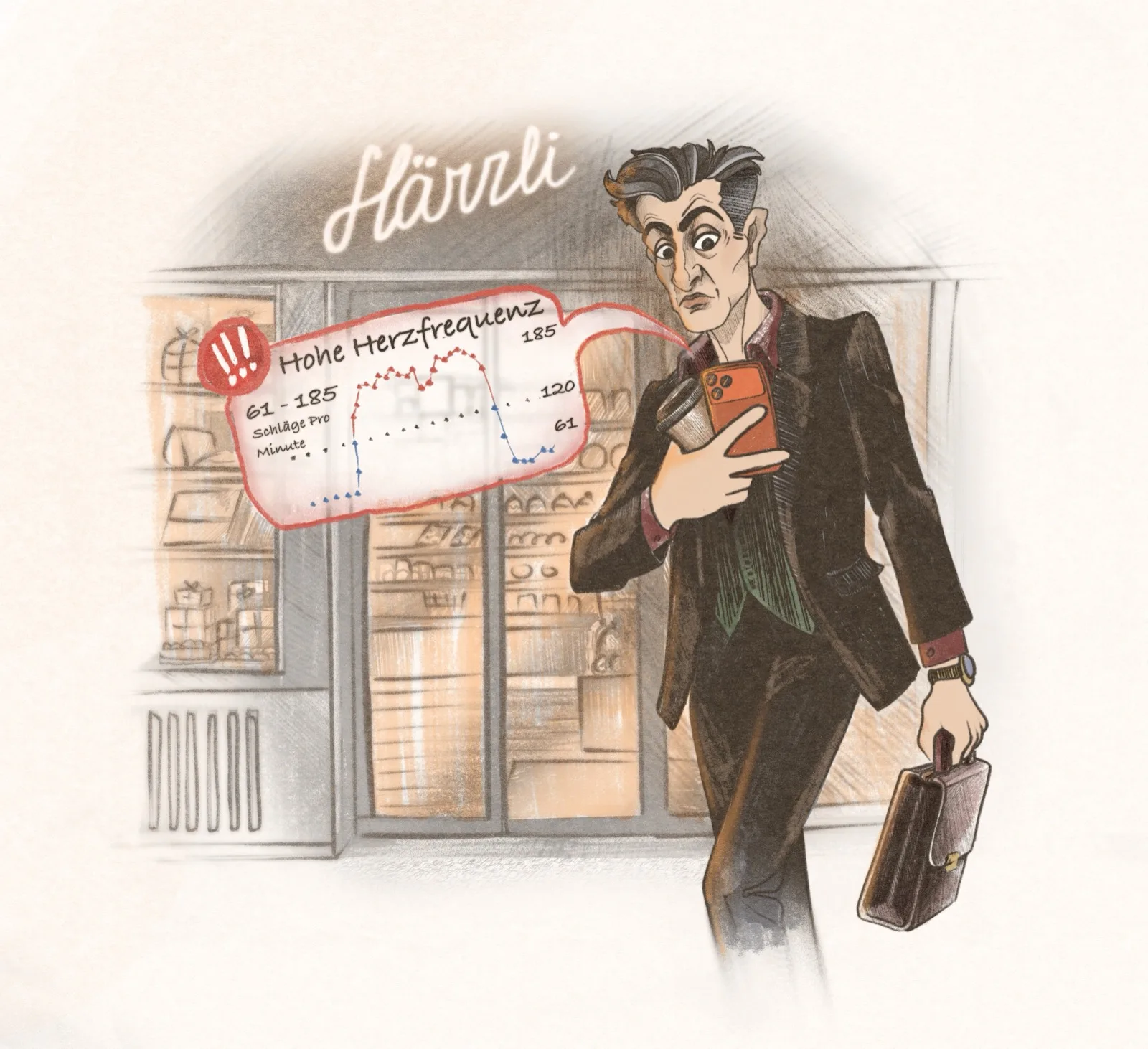
Your blood pressure reading has come back high and you are wondering what that really means. In Switzerland, roughly one in four adults lives with high blood pressure, and around a third of them do not know it [Schweizerische Herzstiftung 2024]. High blood pressure can almost never be felt. That is precisely what makes it dangerous: over the years it silently strains the heart, brain and kidneys. The good news is that with a careful work-up and a treatment that fits your life, the risk can be reduced considerably.
What does arterial hypertension mean and how is it diagnosed?
We speak of arterial hypertension when blood pressure is persistently elevated. In practice, a reading from 140/90 mmHg classically counts as hypertension [Schweizerische Herzstiftung 2024]. A single measurement is often not enough for a diagnosis. In some people the pressure rises only in the consulting room (white-coat hypertension); in others, genuine hypertension hides behind normal practice readings (masked hypertension). Both phenomena are common and cannot be told apart with a single measurement [ESC 2024]. This is why the modern work-up relies on 24-hour blood pressure monitoring. It records the pressure in everyday life, under exertion and in sleep, and maps the night-time profile. From these data, your individual cardiovascular risk can be estimated more reliably than from any single reading. At Dein Team Herzzentrum we combine this long-term measurement with a cardiological examination to detect end-organ damage early.
Why a single reading at the practice is often not enough
Blood pressure fluctuates over the course of the day. Excitement, exertion, coffee or simply the situation at the doctor's briefly raise the reading. A study of patients with a controlled or normal 24-hour profile found a white-coat effect at the practice in around half of them [ESC 2024]. Conversely, an unremarkable reading at the practice misses masked hypertension, which is particularly common in smokers, people with diabetes or the overweight [ESC 2024]. Ambulatory 24-hour monitoring is regarded today as the reference method because it uncovers these misclassifications and predicts cardiovascular events better than practice readings alone. Careful home monitoring over several days provides complementary values but does not replace the night-time profile of the 24-hour measurement.
Why night-time blood pressure matters
Blood pressure behaviour at night is particularly telling. Normally, blood pressure falls by at least ten per cent during sleep. If this drop fails to occur (non-dipping), or if the pressure even rises at night, the risk of stroke, heart failure and organ damage is increased. An analysis of 13,844 people showed that night-time blood pressure predicts cardiovascular events more accurately than daytime or practice readings [Hypertension Research 2024].
A missing night-time drop often has a treatable cause. These include:
- Obstructive sleep apnoea, meaning pauses in breathing at night with loud snoring and daytime tiredness
- Chronic stress and disturbed sleep
- Hormonal disorders, for instance of the adrenal gland
- Advanced kidney disease
Anyone who shows a non-dipping profile should be examined specifically for these causes. Sleep apnoea, once identified, can be treated, and this often improves the night-time blood pressure profile too. Strikingly high night-time readings are therefore a concrete reason to look more closely.
Individual treatment instead of a rigid scheme
Modern hypertension treatment follows your overall risk rather than a single number alone. We consider concomitant conditions, already visible end-organ damage such as hypertensive or coronary heart disease, kidney values and your life situation.
The current European guideline has tightened the target values. For most treated adults, a systolic target range of 120 to 129 mmHg is now recommended, provided it is well tolerated [ESC 2024]. This is a deliberate departure from the earlier strategy of first simply getting below 140 mmHg. One basis for this is the SPRINT trial: in high-risk patients without diabetes, an intensive target below 120 mmHg reduced cardiovascular events by around 25 per cent and all-cause mortality by about 27 per cent compared with the standard target below 140 mmHg [SPRINT 2015, NEJM].
These strict targets do not suit everyone, however. In people aged 85 and over, in cases of frailty, dizziness on standing or limited life expectancy, the principle is to lower the pressure as far as it is well tolerated [ESC 2024]. Here, tolerability matters more than hitting the exact target.
Medication and lifestyle work hand in hand
The drug basis is usually a combination of ACE inhibitors or angiotensin receptor blockers (sartans), calcium channel blockers and diuretics [ESC 2024]. An early combination at low doses often works better and more gently than the maximum dose of a single agent. Which agents suit a given person depends on age, kidney function and concomitant conditions, and is readjusted over time.
What you do yourself remains just as important. A diet lower in salt lowers systolic pressure measurably: in an analysis of 85 studies, it fell by up to 6.7 mmHg when salt intake was reduced from high to low [CKJ 2025]. The DASH diet, rich in vegetables and fruit and low in salt, lowered the systolic reading in people with hypertension by around 11 mmHg [NEJM 2001]. Add to this regular exercise, a healthy weight, moderate alcohol consumption and stopping smoking. Medication and lifestyle complement each other, and the earlier both take effect, the smaller the risk remains.
The key points at a glance
- High blood pressure often goes unnoticed for years because it causes hardly any symptoms.
- Untreated, it raises the risk of heart attack, heart failure, stroke and kidney damage.
- 24-hour blood pressure monitoring is the diagnostic reference method and uncovers white-coat and masked hypertension.
- Night-time blood pressure carries high prognostic significance. A missing night-time drop should prompt investigation for sleep apnoea and hormonal causes.
- For most people under treatment, a systolic target of 120 to 129 mmHg applies today; in the very old or frail it is adjusted individually.
- Lifestyle and modern medication work together and improve life expectancy.
Frequently asked questions about arterial hypertension
From what reading do I have high blood pressure?
Classically, practice readings from 140/90 mmHg count as hypertension [Schweizerische Herzstiftung 2024]. What matters, though, is the overall picture across several measurements, ideally supplemented by a 24-hour measurement. A single high reading after a stressful day is not yet a diagnosis.
Why do I need 24-hour blood pressure monitoring?
Because a single reading at the practice can be misleading. Long-term monitoring shows whether your pressure rises only at the doctor's or is also elevated in everyday life and at night. Your cardiovascular risk can then be assessed more accurately than from single readings [ESC 2024].
Can high blood pressure be felt?
Usually not. The vast majority of people do not notice high blood pressure for years. That is exactly why regular checks are worthwhile, especially from middle age onwards or with a family history.
Do I have to take medication for life?
Often yes, because high blood pressure is usually a chronic condition. In some people, the dose and number of medications can be reduced through consistent lifestyle changes. Treatment is reviewed and adjusted regularly.
What can I do myself about high blood pressure?
Cut down on salt, exercise regularly, maintain a healthy weight, enjoy alcohol in moderation and do not smoke. A diet lower in salt and rich in vegetables can lower systolic pressure by several mmHg [NEJM 2001]. These measures reinforce the effect of any drug treatment.
What role does sleep apnoea play in blood pressure?
A major one. Pauses in breathing at night keep blood pressure high during sleep and often lead to a missing night-time drop. Once sleep apnoea is identified and treated, the night-time blood pressure profile frequently improves as well.
When should I have a cardiological work-up?
A cardiological work-up makes sense with persistently elevated readings, an abnormal 24-hour profile, known heart or kidney disease, or blood pressure that remains hard to control despite treatment. End-organ damage and treatable causes can then be sought specifically.
This article is for information purposes and does not replace a personal medical assessment. If you would like your blood pressure assessed, the team at Dein Team Herzzentrum in Zürich is here for you.